The Ultimate Guide To Branded Apparel: Fabric, Fit, Decoration, And Sizing

The Ultimate Guide To Branded Apparel: Fabric, Fit, Decoration, And Sizing

The Ultimate Guide To Branded Apparel: Fabric, Fit, Decoration, And Sizing

Featured

Featured

Featured

The Ultimate Guide To Branded Apparel: Fabric, Fit, Decoration, And Sizing

The Ultimate Guide To Branded Apparel: Fabric, Fit, Decoration, And Sizing

The Ultimate Guide To Branded Apparel: Fabric, Fit, Decoration, And Sizing

In this blog, we discuss everything you need to know about branded apparel swag in 2026.

In this blog, we discuss everything you need to know about branded apparel swag in 2026.

In this blog, we discuss everything you need to know about branded apparel swag in 2026.

Last Update:

LastUpdate:

Last Update:

8

8

min read

min read

A t-shirt, a sweatshirt, and a jacket.
In this Post

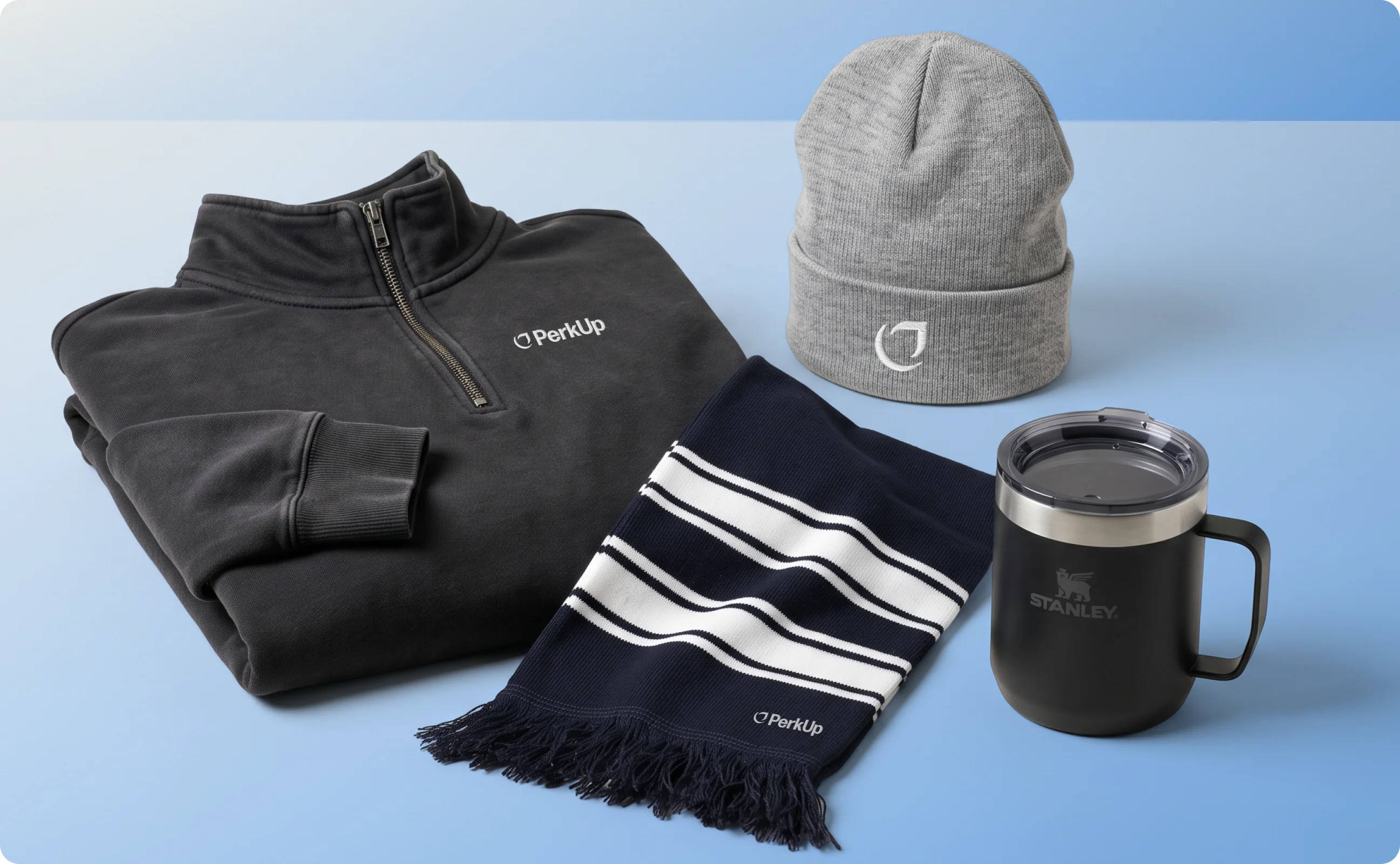
Somewhere in your office, there’s probably a box of company t-shirts that nobody claimed. The reason may be that they’re the wrong size, the cotton is too stiff, it pills too easily, or the logo is so big it’s horrendous. And then you have that quarter-zip that you ordered for your team two years ago that’s still worn around the office, especially during cold days.

So, what’s the difference between those t-shirts and those quarter-zips, when they have the same budget but have completely different outcomes?

The difference lies in a lot of things. After all, buying branded apparel involves the fabric choice, the decoration method, fit, and fulfillment model. In this guide, we’ll break down the decisions that have the biggest impact on apparel swag and how you can apply them in your own swag campaigns.


What counts as swag apparel?

Swag apparel is any branded clothing you give to your employees, customers, event attendees, or partners. These pieces of clothing fall into five categories:

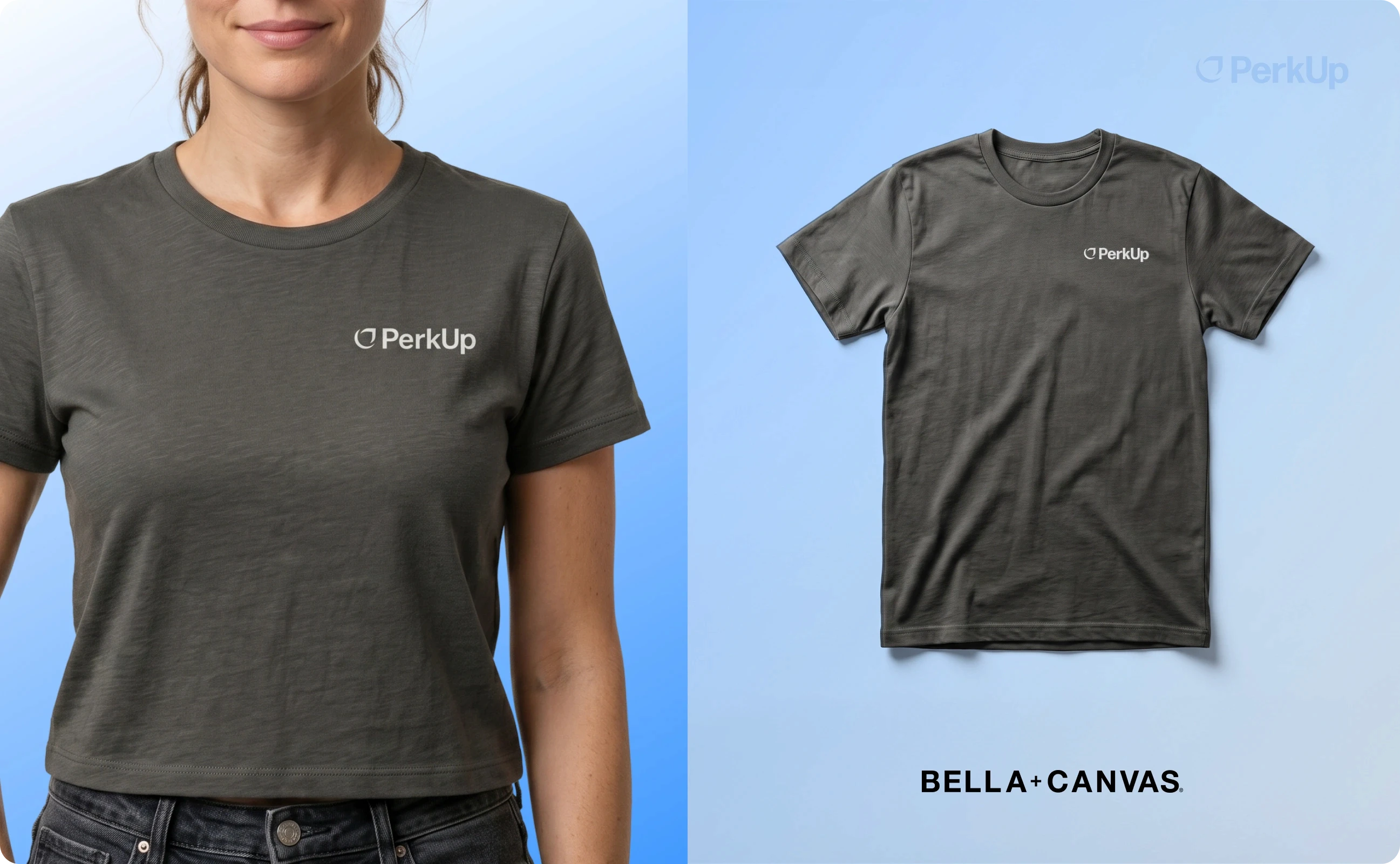
  1. Tees and tops

This is the foundation of most apparel swag programs. They're affordable, easy to size, and common in onboarding kits and recruiting events.

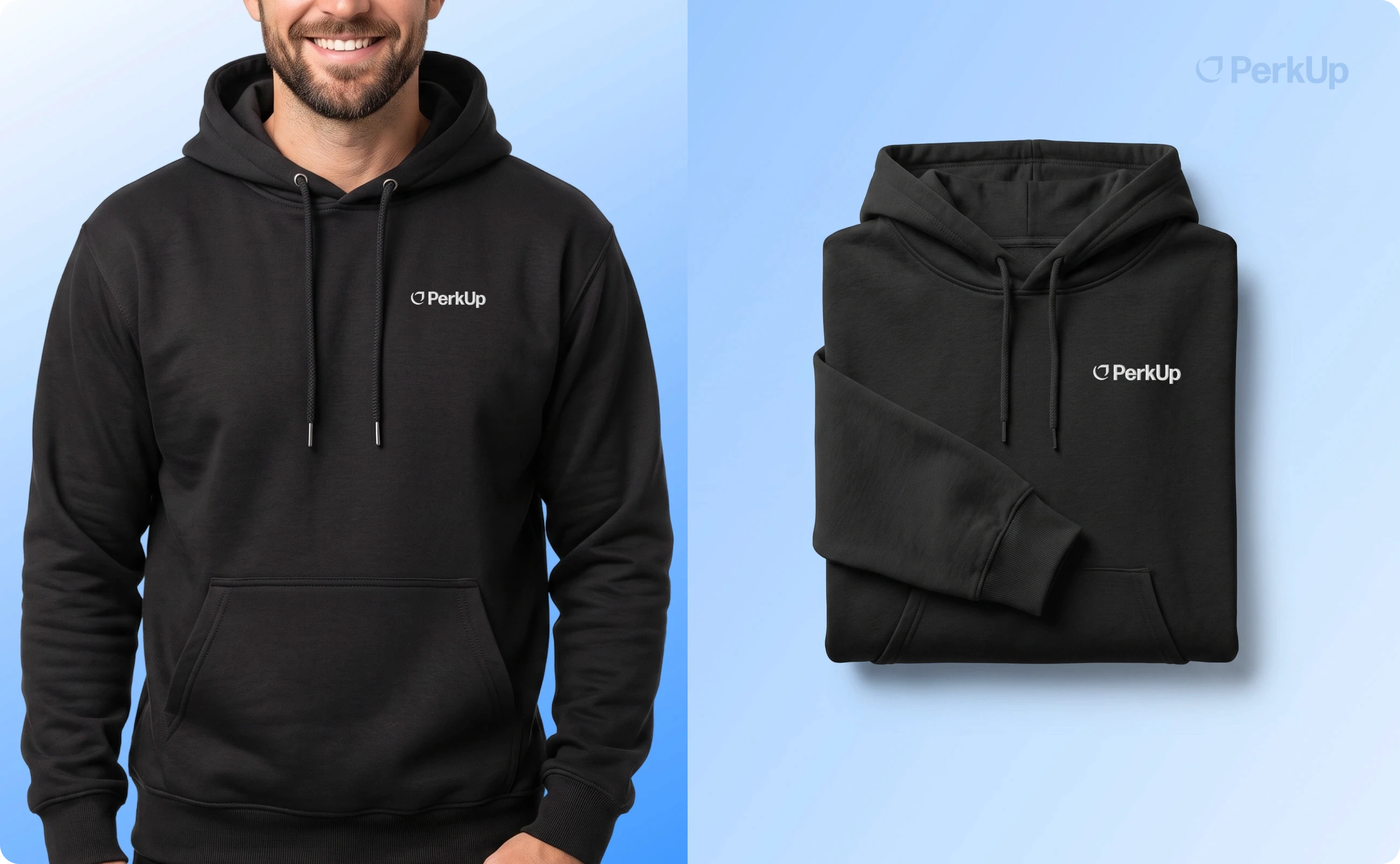
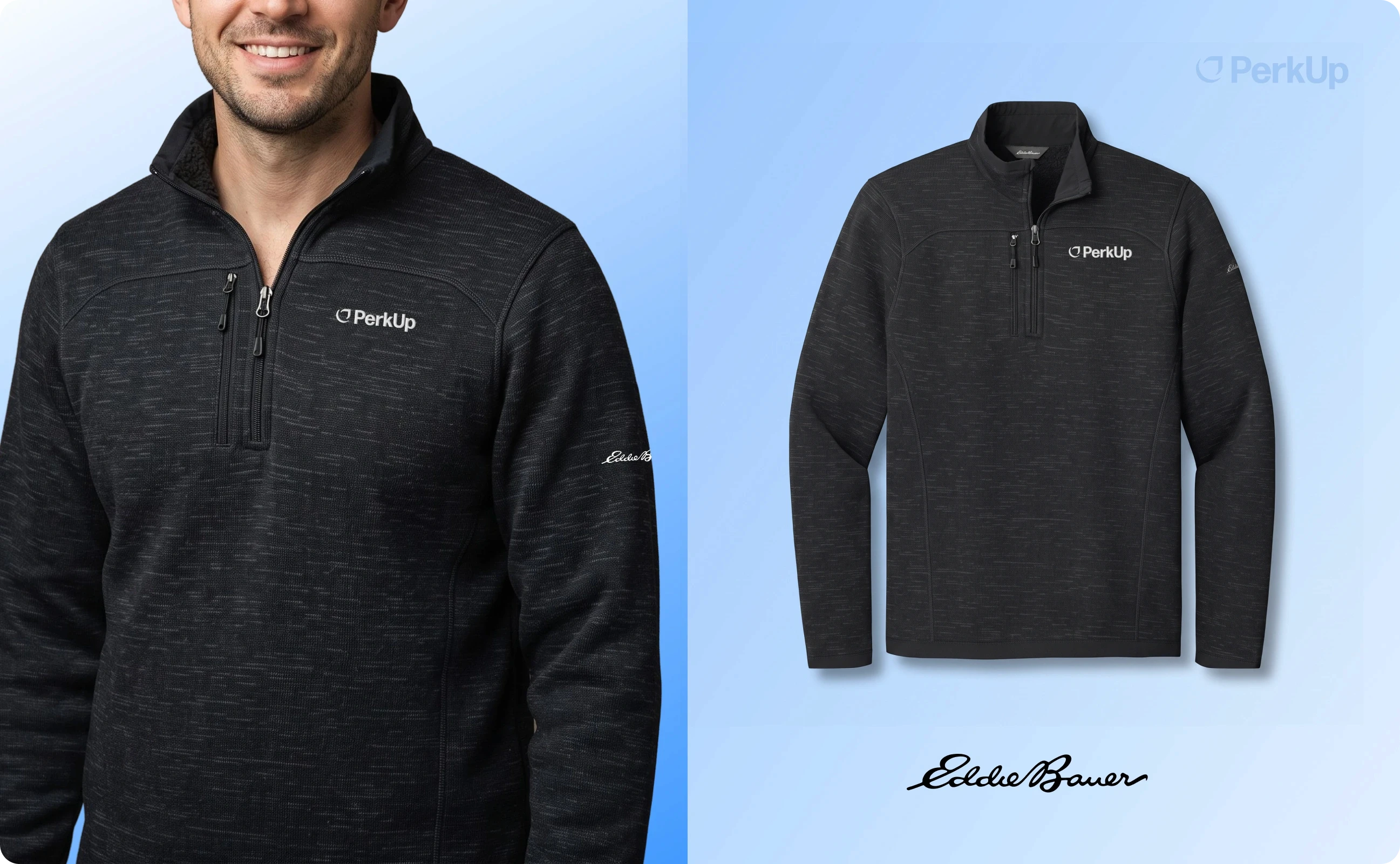
  1. Mid-layers

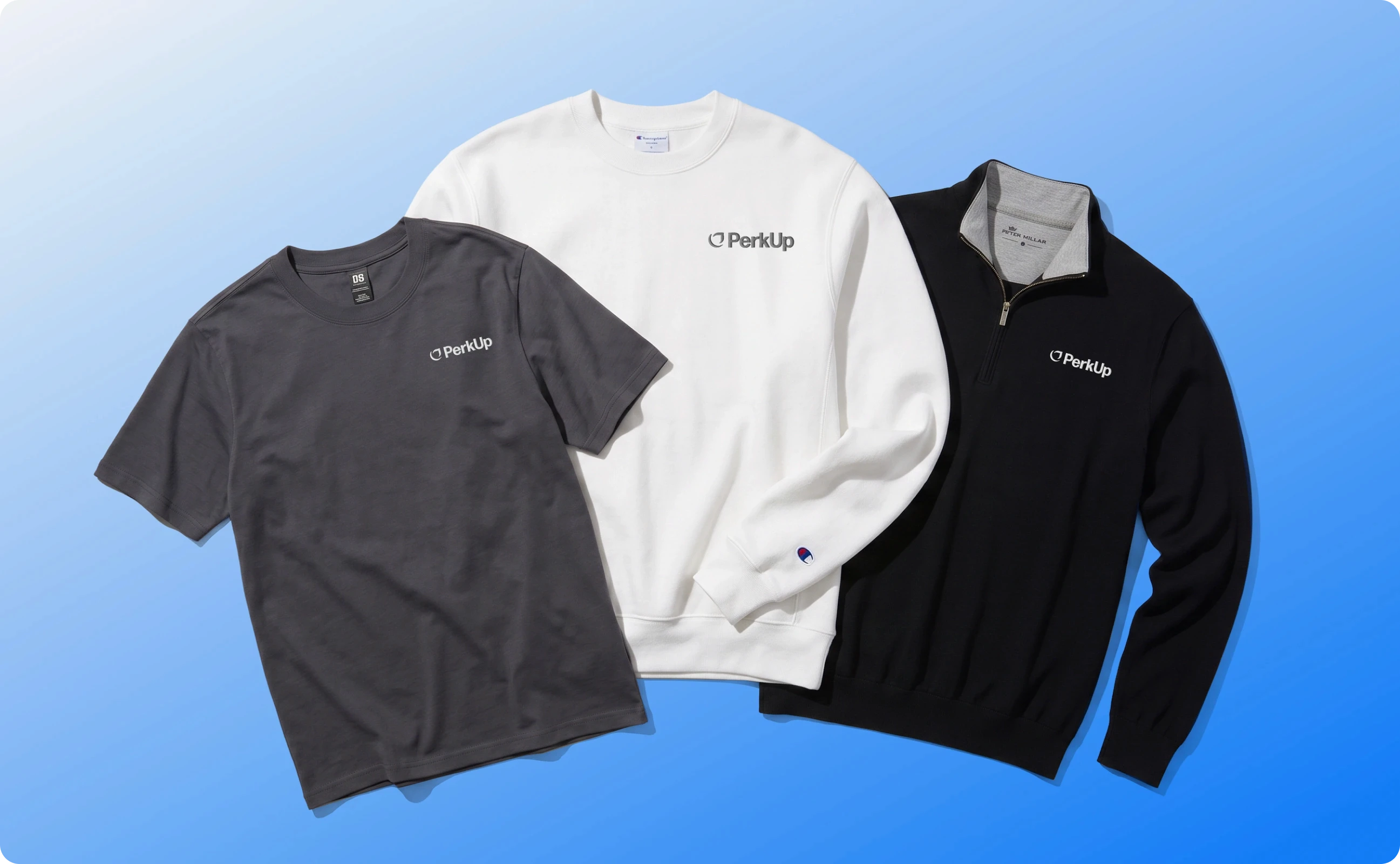
Hoodies, crewnecks, and quarter-zips belong in this category. These apparel items tend to be the ones that your recipients will likely keep the longest. As such, they’re popular for company anniversaries and holiday sends.

  1. Outerwear

Some examples of outerwear are jackets, fleece, and vests. They’re usually reserved for leadership gifts, sales incentives, customer appreciation, or longer-service awards because of the higher price point.

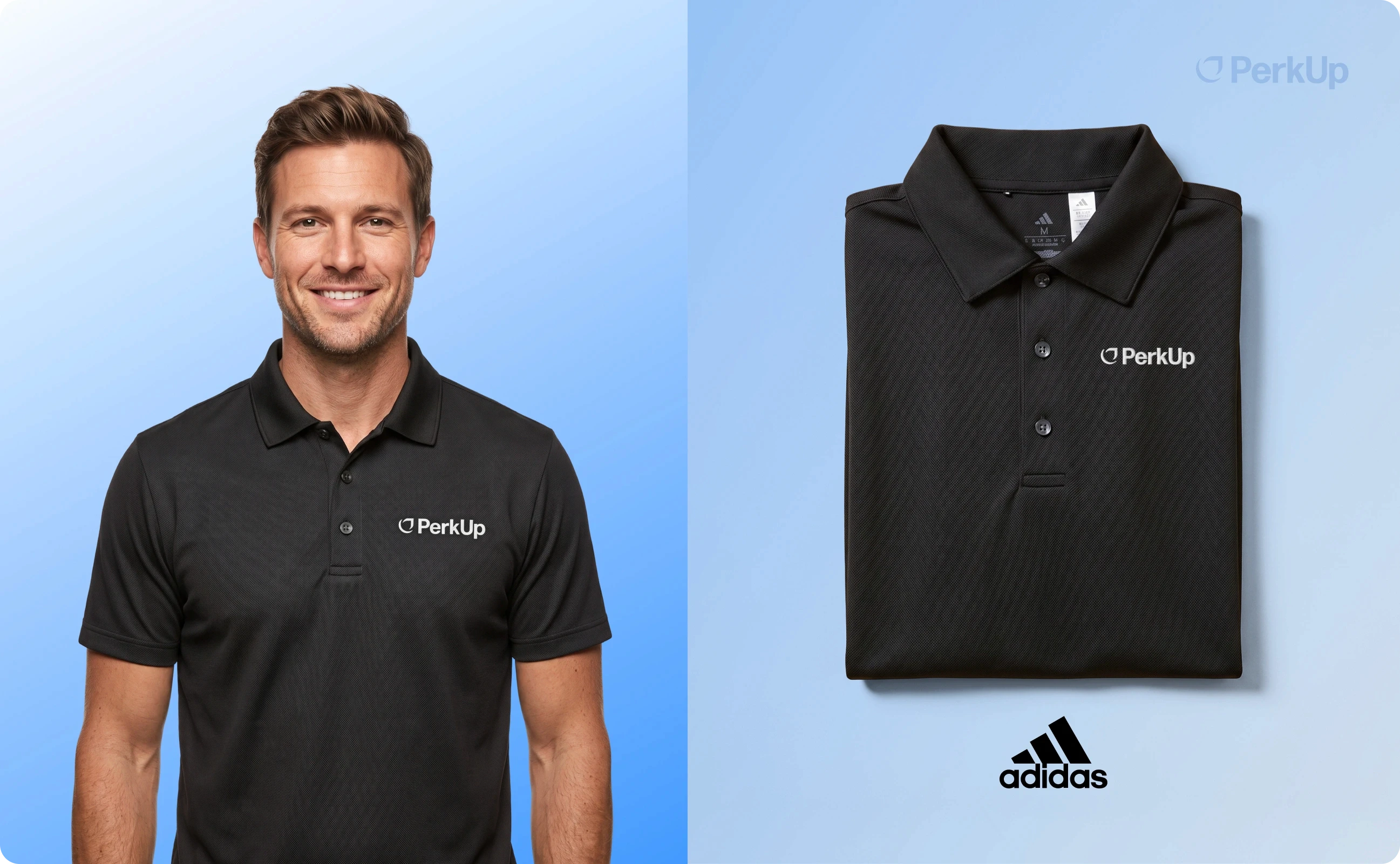
  1. Collared shirts

It’s easy to lump collared shirts with tees, but they serve a different purpose. Polos and woven button-downs give client-facing teams something more polished than a t-shirt without feeling overly formal.

  1. Bottoms

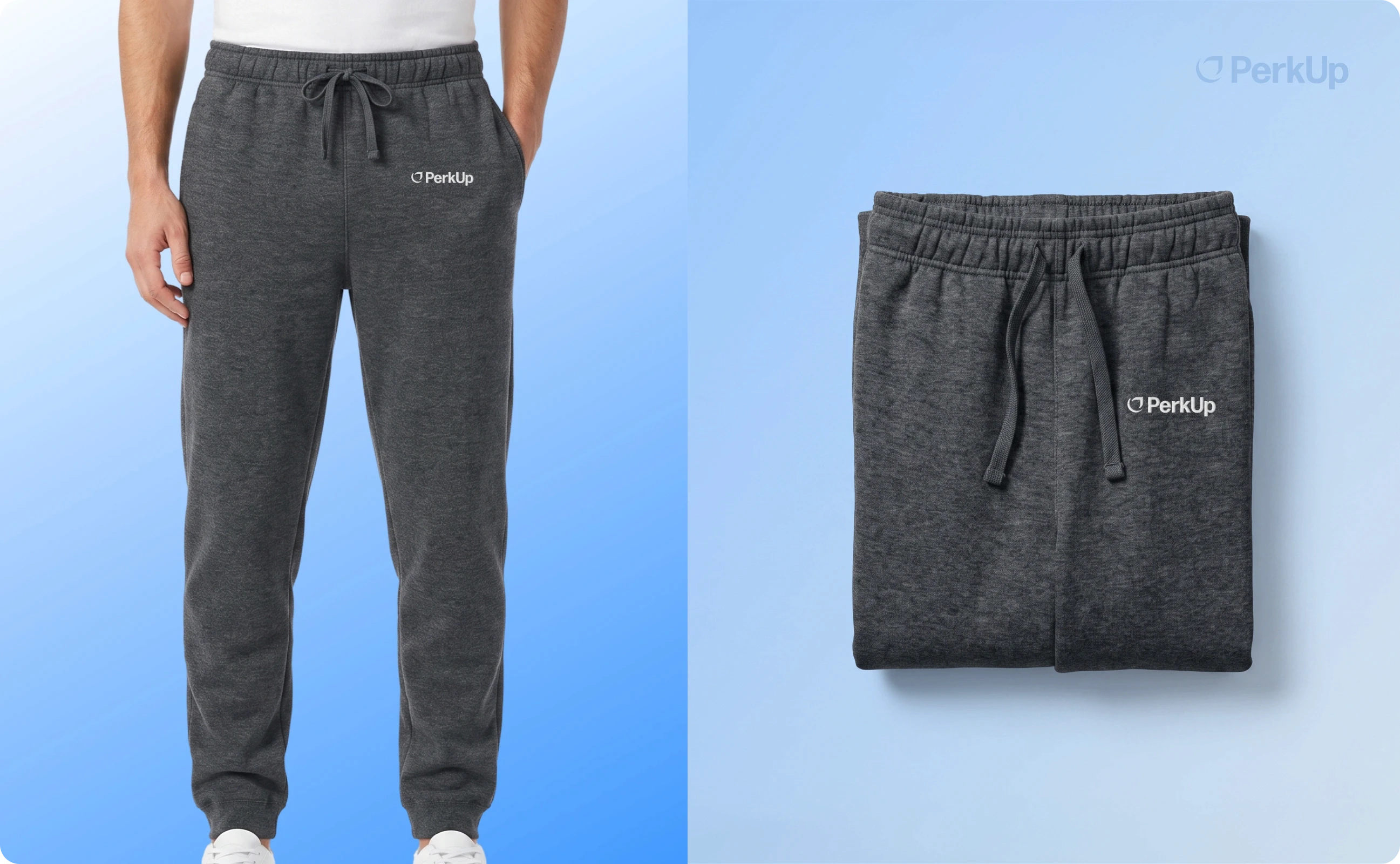
These include joggers, sweatpants, and shorts, which are most often paired with hoodies or crewnecks to create matching sets for different types of swag campaigns.

One distinction is worth making before we go any further. Uniforms are something people have to wear. Swag is something they choose to wear. That said, that particular difference shapes almost every decision you'll make, from fabric and decoration to fit and brand.

You might also see swag vendors use different names for the same thing: company apparel, branded apparel, corporate apparel, or corporate swag. While yes, the wording changes, the buying decisions don’t.


Why Apparel Outperforms Almost Every Other Swag Category

The biggest advantage of apparel is that people keep wearing it.

Let’s take, for example, the data from ASI's 2026 Ad Impressions Study, where four in five consumers keep a promotional t-shirt for at least a year, and nine in ten wear it at least once a month. If you transform that into advertising numbers, that works out to roughly 3,500 impressions or about ⅓ of a cent per impression! Outerwear performs even better, as it generates around 9,000 impressions over its lifespan while staying under half a cent per impression. That’s cheap but effective advertising.

The value isn't just in the visibility, but also in how your recipients feel about receiving it. PPAI's Product Power 2026 study, which surveyed more than 5,000 U.S. consumers, found that 83% said receiving a branded product made them feel appreciated, while 90% said it improved their perception of the company that gave it to them. In those numbers, apparel consistently ranks among the categories people are most likely to keep and use.

But, of course, there’s also a flip side here. Bad apparel won’t and doesn’t stick around for long. If the fabric feels cheap or the decoration starts cracking after a few washes, then you can bet that they’ll end up in the closet or the trash.

This, then, makes it all the more important to find the best apparel for your swag needs.


How do you choose the right fabric for company apparel?

The quickest way you can judge if the apparel is a good fit for your swag program is to go straight to the spec sheet. There, there will be three things that tell you almost everything you need to know: the fiber content, the way the yarn was spun, and the fabric weight. Everything after that comes down to preference.

In any case, let’s see what you need to know when choosing custom branded apparel for your swag campaigns.
  1. Cotton and how it was spun

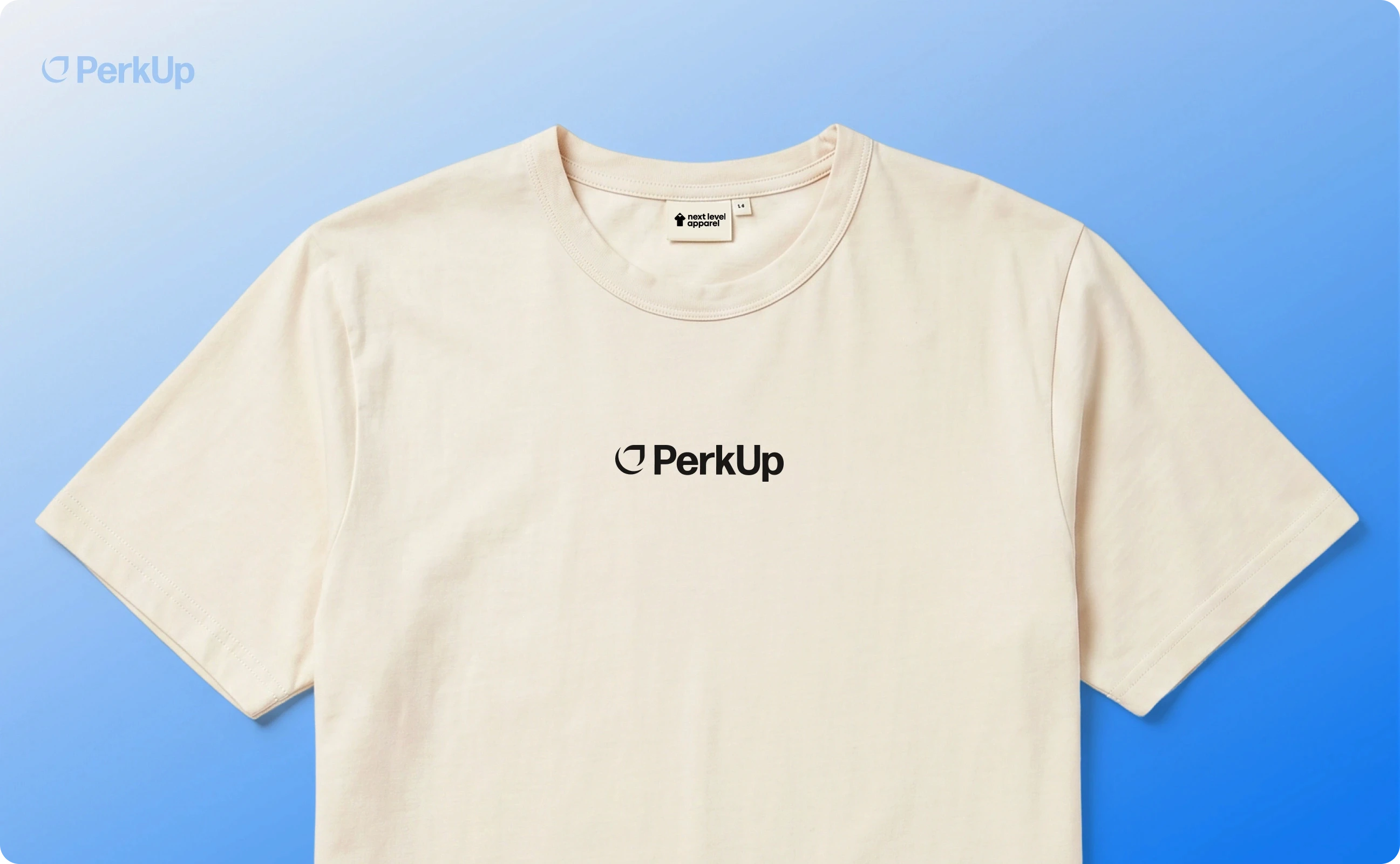
Not all cotton feels the same. Open-end cotton is spun quickly in a rotor, making it the most affordable option. It has a rougher hand feel, which is why it dominates budget t-shirts and basic workwear. Ring-spun cotton is twisted into a tighter, smoother yarn, which produces a softer fabric with a cleaner surface for decoration. This makes it the standard for better-quality branded apparel. Combed ring-spun cotton adds another step before spinning by removing the shorter fibers. The result is an even smoother fabric that pills less and generally holds up better over time.

You'll also see singles on some spec sheets. Singles basically measures the fineness of the yarn, meaning the higher the number of singles, the finer the yarn.

One simple rule to ask your swag vendor: if a t-shirt only says “100% cotton” without mentioning how it was spun, ask. 

  1. GSM and ounces

US manufacturers usually list fabric weight in ounces per square yard (oz), while most of the rest of the world uses grams per square meter (GSM). They’re essentially measuring the same thing, just in different units. That said, if you divide GSM by 33.9, you can convert it to ounces.

Here’s a general guide on how GSM/ounces appear on apparel spec sheets:

  • Under 130 GSM (below 3.8 oz) is usually a giveaway-weight apparel, often thin enough to see through

  • 130 to 150 GSM (3.8 to 4.4 oz) is a lightweight tee that's comfortable in warmer weather 

  • 150 to 180 GSM (4.4 to 5.3 oz) is the everyday midweight range where most quality blanks are in

  • 180 to 200 GSM (5.3 to 5.9 oz) means the apparel has more structure and drape without feeling bulky

  • 200 GSM and above (5.9 oz and above) moves into heavyweight territory

A tip: don’t mistake heavier for better. For instance, a 160 GSM combed ring-spun tee will usually outlast and outfeel a 240 GSM open-end tee because fiber quality matters more than weight alone.

  1. Blends, fleece, and performance fabrics

Cotton isn't always the right choice. For one, a 50/50 cotton-poly blend shrinks less, wrinkles less, and takes screen printing well. This actually makes it one of the most common choices for event apparel. Tri-blends, on the other hand, combine cotton, polyester, and rayon for a softer drape that feels closer to retail clothing than traditional promotional apparel. Performance polyester is built for moisture-wicking and athletic use, although it needs decoration methods designed specifically for synthetic fabrics. For hoodies, crewnecks, and joggers, fleece typically ranges from 8 to 13 oz. Around 8 oz feels like everyday loungewear, while 10 oz and above start to feel closer to premium retail apparel.

Specs to check before approving a sample

With the 3 things mentioned above, here’s what you need to check before approving a sample for a company apparel item:

  1. Fabric weight - Check the GSM or ounce weight for the exact color you're ordering, since heather colorways often use different blends and weights.

  2. Spinning method and singles - Combed ring-spun cotton in the 30s or 32s is a practical quality floor for a t-shirt people will actually keep wearing.

  3. Side-seamed vs. tubular construction - Side-seamed garments hold their shape better through repeated washing, while tubular garments are more likely to twist over time.

  4. Pre-shrunk or garment-dyed fabric - Untreated cotton can shrink 5% to 10% after the first hot wash, which is close to a full size on a T-shirt. Pre-shrunk and garment-dyed fabrics usually keep shrinkage to just a couple of percent, with most of that happening during the first few washes.

  5. Size range - Don’t opt for a style that only runs from S through XL, as you may have unknowingly already excluded a part of your team.

As a point of reference for a good choice for an apparel item, BELLA+CANVAS lists its popular 3001 tee at 4.2 oz, made from 100% Airlume combed and ring-spun cotton, 32 singles, pre-shrunk, side-seamed, and available from XS through 4XL.


What People Actually Want to Wear Now

Company apparel has shifted toward retail. While the lightweight promotional tee with a large logo across the chest isn’t completely gone, it's no longer what most people will wear. Employees want apparel they'd wear outside of work, and companies are starting to order accordingly.

Here are five trends that stand out:

  • Heavyweight fabrics - The biggest apparel trend for 2026 is people looking for heavyweight fabrics, with 62% of buyers planning to try heavier-weight garments.

  • Garment-dyed and washed colors - Half of buyers want to move away from bright basics in favor of softer, lived-in colors.

  • Boxy, drop-shoulder fits - 46% now prefer relaxed silhouettes over the slimmer cuts that dominated the last decade.

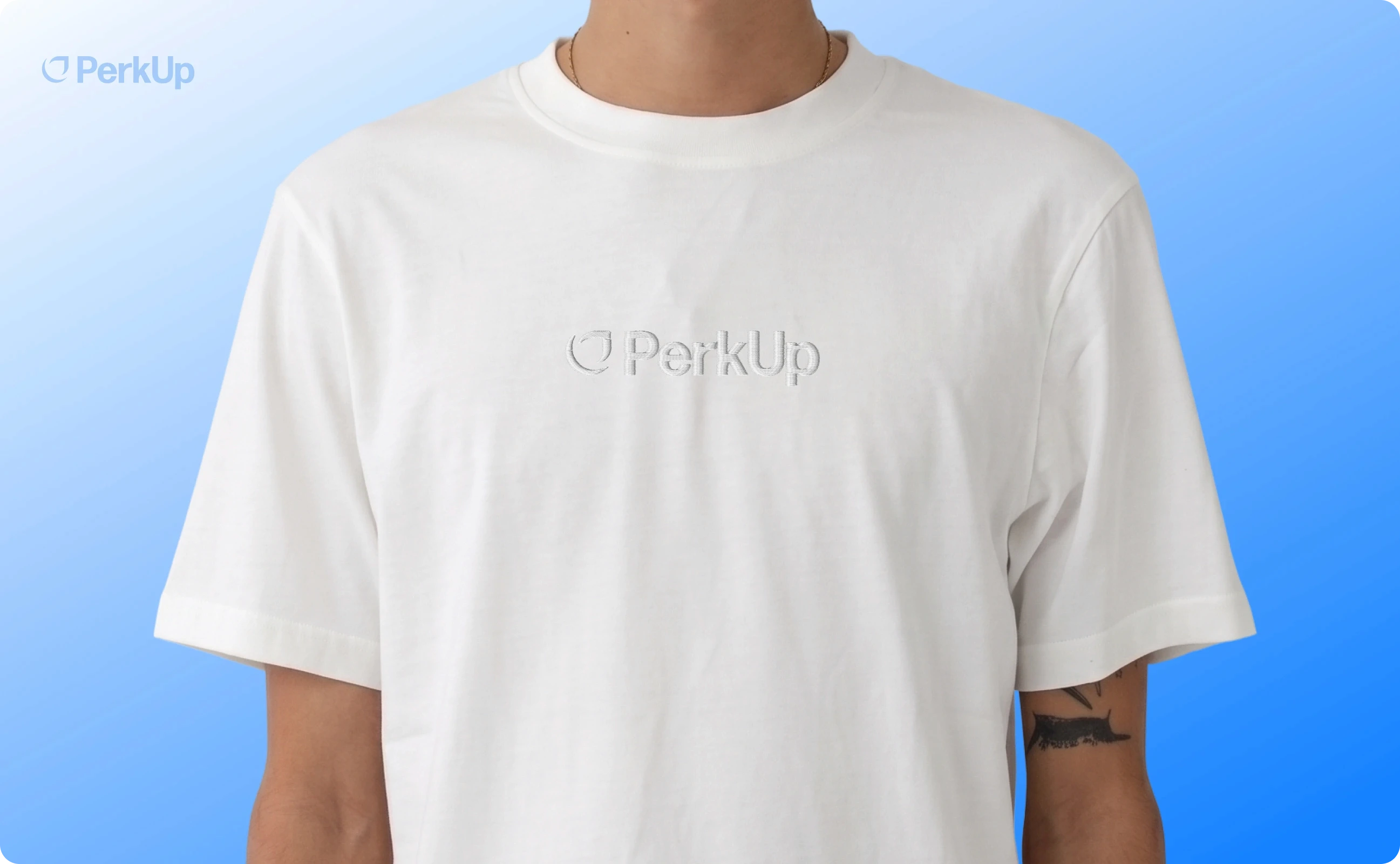
  • Smaller logos - Tone-on-tone embroidery and thread matched to the garment have become the standard for employee apparel, while event swag still makes room for larger front graphics.

  • Styles that work outside the office - Quarter-zips and premium hoodies continue to gain ground because people can wear them on a client call, to the grocery store, or over the weekend.


Tips To Get Apparel Sizing Right

If you don’t want to waste your apparel budget, then don’t guess sizes. For example, a size run that stops at XL isn’t covering the average population, let alone your global team. If your order doesn’t account for the average waist circumference of 40.6 inches for men and 38.5 inches for women aged 20 and over in the US, then someone in your recipient list will be left out.

If you haven’t collected sizes yet, you can start with a working distribution and adjust it based on your audience and region:

  • Small: 10%

  • Medium: 30%

  • Large: 35%

  • XL: 20%

  • XXL: 5%

Treat that as a starting point for a first order, not a replacement for collecting real sizes.

There are also a few habits that can make a much bigger difference than trying to predict the perfect ratio:

  • Order XS through 4XL whenever the style offers it

  • Unisex is usually a good fit for a large recipient group

  • Publish chest and body-length measurements alongside letter sizes, since an XL can vary significantly between brands

  • Collect sizes during onboarding or event registration, not after the apparel has already been ordered

  • Add a small buffer at both ends of the size range

The best long-term solution is to stop guessing altogether. For this, you can either opt for a swag store or order On Demand. A company swag store lets each recipient choose their own size and style before anything is produced. With On Demand swag, every order is made individually with a 1-unit minimum, so you’re not left holding forty unworn medium T-shirts. What’s more, that 1-unit minimum is what actually solves the sizing problem. Nothing gets produced until someone tells you what they need, which means no size curve to forecast and no leftover inventory. For teams spread across several countries, where sizing conventions differ market to market, it removes the guesswork entirely.


Which decoration method should you use for apparel?

Here's the short version of which method suits which garment.

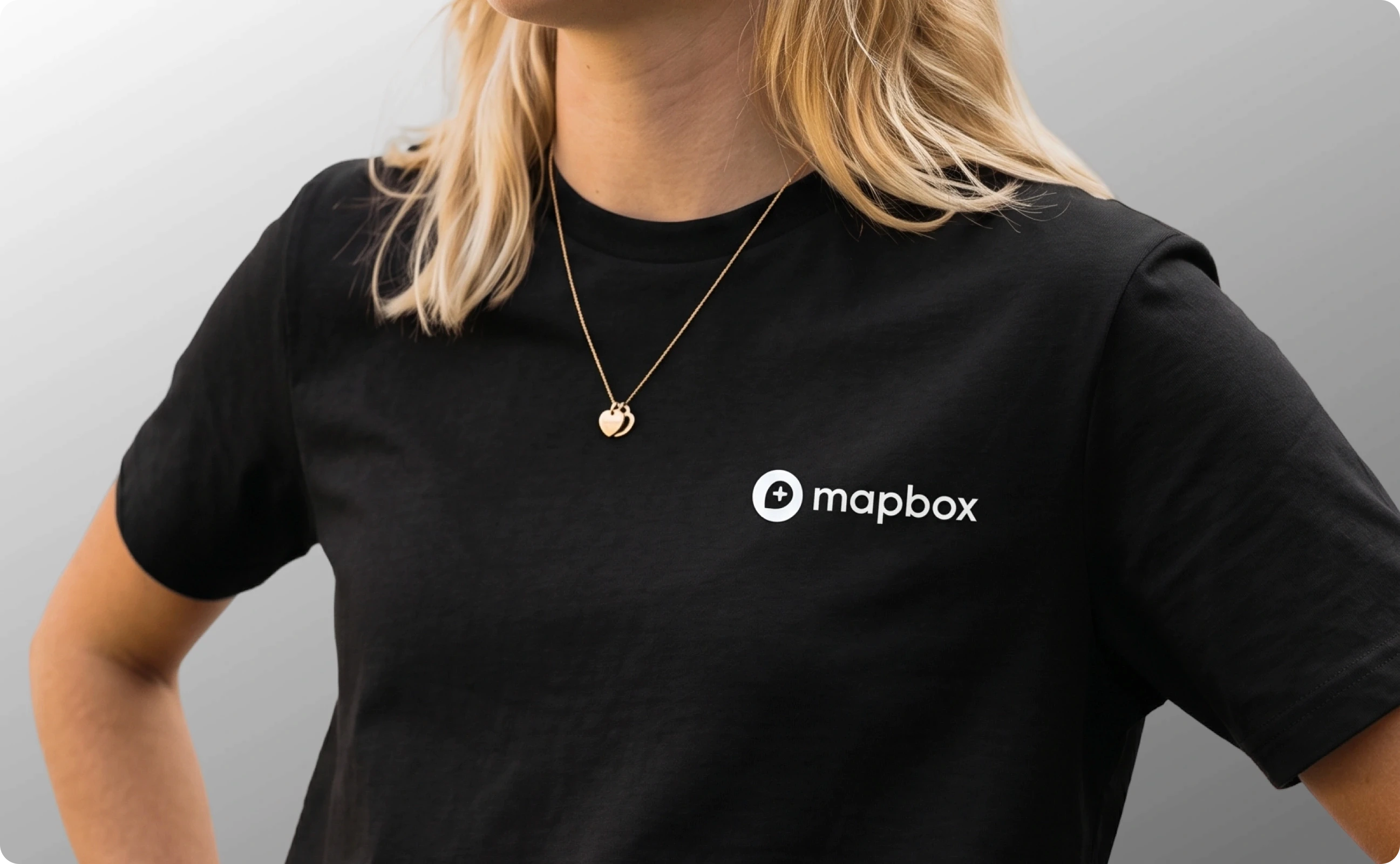
  1. Screen printing

The most cost-effective option for large runs, with the price per garment dropping quickly once you're ordering 50 or more.

Best used on: heavyweight cotton tees, cotton hoodies, cotton crewnecks

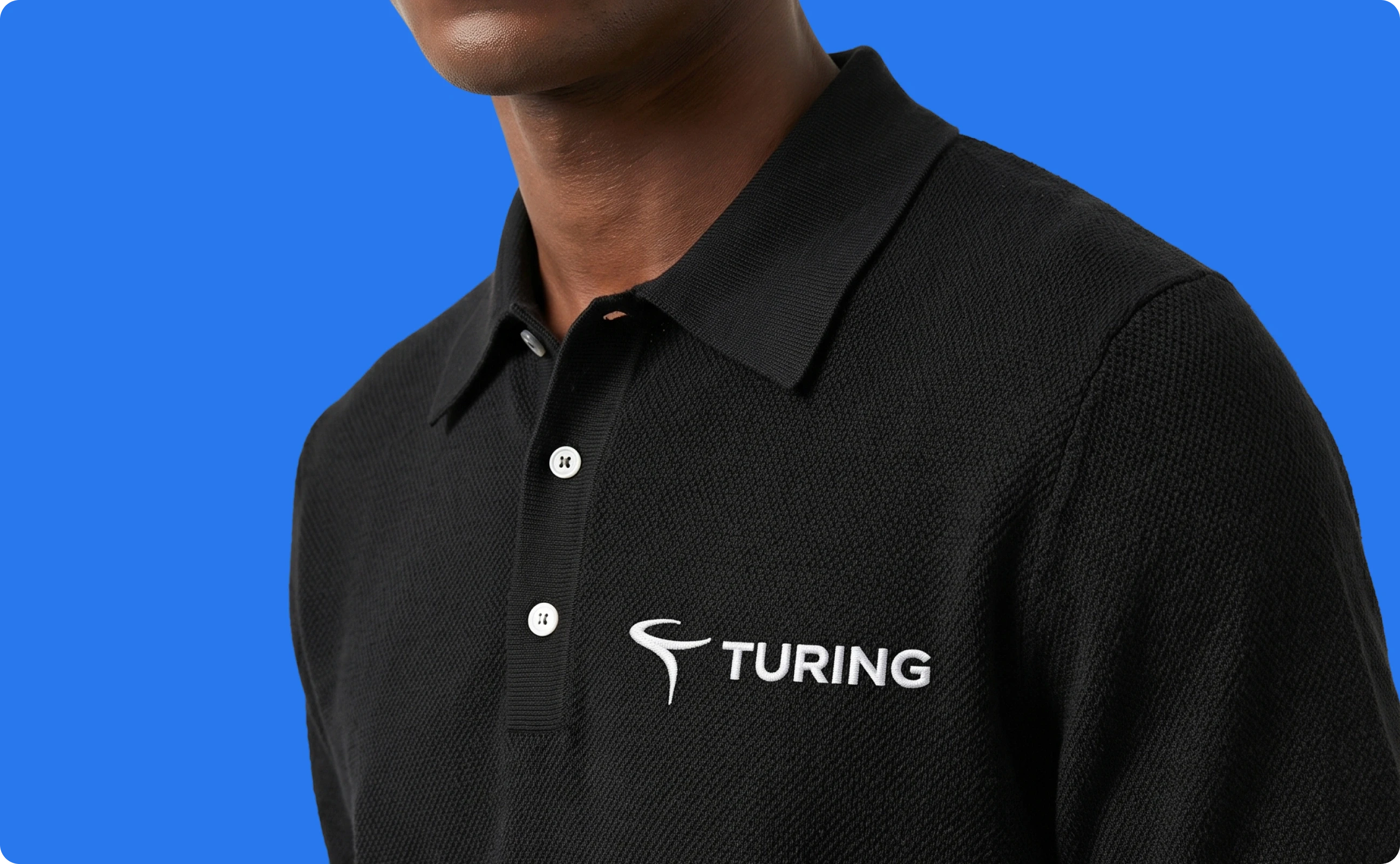
  1. Embroidery

Priced by stitch count rather than color count, and the longest-lasting of the four. Tone-on-tone thread has become the standard for employee apparel.

Best used on: pique polos, quarter-zips, jackets and softshells, vests, joggers

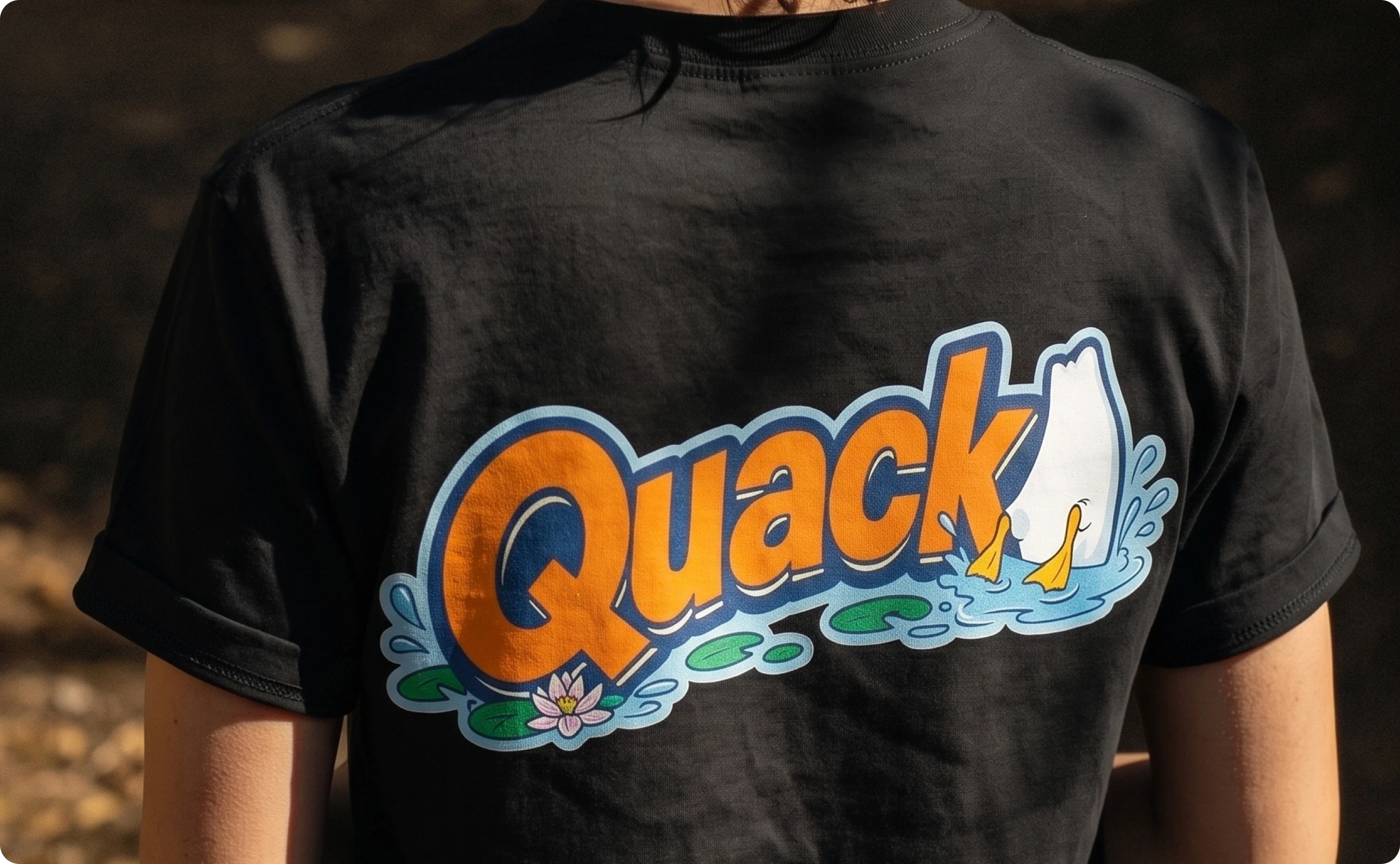
  1. Direct to garment (DTG)

No screens, no setup fees, and no minimums, so a full-color design costs the same as a one-color logo. Best on cotton, less consistent on polyester and heavier blends.

Best used on: 100% cotton tees, cotton tanks, cotton long-sleeve tees, cotton crewnecks, cotton hoodies

  1. Direct to film (DTF)

Works on cotton, polyester, and blends equally, which makes it the default for performance apparel.

Best used on: performance tees, performance polos, poly quarter-zips, athletic shorts, blended fleece hoodies

For a deeper comparison, PerkUp's guide to customization methods covers embroidery, screen printing, DTG, DTF, and the situations where each should be used.


How should you design apparel people actually want to wear?

Most companies choose the garment first and worry about the artwork later. It usually works better the other way around because the color, fabric, and decoration method all affect what your design can actually do.

  1. Tone-on-tone

Tone-on-tone decoration matches the thread or ink to the garment color. The logo is easy to spot up close, but fades into the garment from across the room. It's become the default look for employee apparel as of late because it feels more like retail than promotional swag. 

  1. Start with the garment color

Garment-dyed and washed colors already have a softer look, so low-contrast artwork can disappear completely on heathers and faded fabrics. Dark garments usually require a white underbase when screen printed, which adds another screen and another production pass.

  1. Get the artwork production-ready

The decoration method also determines how your artwork should be prepared. Screen printing and cut vinyl require vector artwork, usually supplied as an AI, EPS, or SVG file. Embroidery needs the artwork digitized into a DST file before production begins. That's usually where fine lines, small text, and intricate details start disappearing if the original logo wasn't designed for stitching. DTG and DTF are priced by print size rather than color count, so it's usually smarter to design within the intended print area.


Where should the logo go?

Placement matters almost as much as the decoration method. A standard left-chest logo usually measures 2.5 to 4 inches wide by 1 to 2 inches tall, and it's the default for company apparel because it looks balanced on almost every garment. 

Here's where to put your logo on apparel, and what each placement is best suited for:

  1. Left chest: The standard choice for company apparel. It’s usually around 2.5 to 4 inches wide by 1 to 2 inches tall. It stays balanced across different garments and body types.

  2. Full front: Best for event apparel and full visibility.

  3. Sleeve: This placement works especially well alongside a left-chest logo.

  4. Nape print or custom inside label: These placements are barely visible when worn.

  5. Bottoms: Logos typically sit on a jogger’s or sweatpants’ left hip, run vertically down the leg, or appear as a small detail on the back pocket.

Sleeve hits, nape prints, and inside labels are relatively inexpensive upgrades, though each additional placement incurs its own decoration charge.


Choosing Apparel Brands For A Swag Program

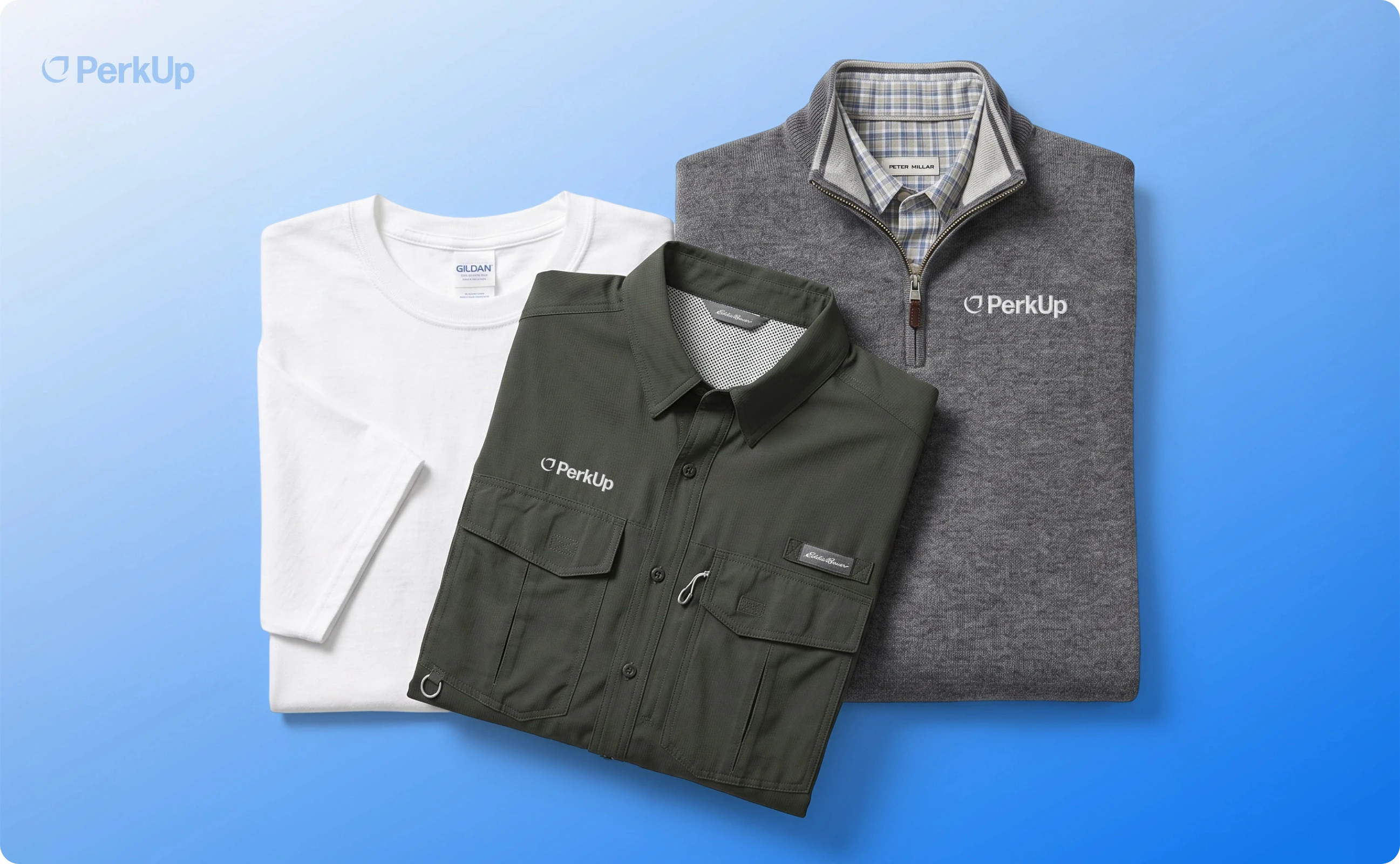
The brand on the tag matters more than you might expect. In Custom Ink's 2026 Swag Trends Survey, 91% of respondents said their team feels more valued receiving a recognized retail brand than a generic private-label item. That doesn't mean every program needs Patagonia, though. The goal is to match your brand to your audience, your budget, and the occasion. 

Some apparel brands by tier

  1. Entry: Gildan and BELLA+CANVAS 

  2. A step up: AS Colour and Stanley/Stella

  3. Mid-tier: Eddie Bauer, Mercer+Mettle, and Port Authority

  4. Premium: Nike, Adidas, The North Face, and Carhartt 

  5. Executive: Patagonia, Peter Millar, TravisMathew, and Brooks Brothers

The ultimate rule of thumb here is you need to build your swag program around the occasion and your recipients. 


 Shipping Swag Apparel to Global Teams

There are a couple of things you should know about when you’re sending swag apparel to your global teams:

  1. Use the same decoration method across every region. Mixing DTG in one country with screen printing in another produces noticeably different-looking garments.

  2. Approve one physical sample before production. Once the sample is right, repeat that specification everywhere.

  3. Produce close to your recipient. Shipping every order from the US adds unnecessary customs delays and increases the chance of lost shipments.

  4. Ship DDP whenever possible. Prepaid duties mean your recipient won’t have to pay an unexpected customs bill.

  5. Check brand availability before approving a style. More international apparel orders fall apart because of brand restrictions than because of price.


What changes when you ship apparel to different countries?

The five tips above are general rules or advice you should follow. However, there are specific changes when it comes to different countries.

  • The UK and Europe - Apparel generally clears customs without much trouble, but clearance still adds time to the delivery. We cover that in more detail in our guide to sending swag to the UK.

  • Canada - Canadian recipients tend to respond well to domestically produced apparel, and heavier layers outperform lightweight styles for much of the year. Our guide to shipping swag to Canada covers the full details of this.

  • Mexico - Local suppliers already handle apparel well in Mexico, so producing within the country is usually faster and more cost-effective than shipping garments across the border. Check out our guide to shipping swag to Mexico to see what else you need to learn about sending swag to this country.

  • India - New apparel isn't restricted, but the import costs add up quickly. India has no de minimis threshold, so even a single hoodie can be assessed for duties and taxes. Our guide to sending swag to India breaks it down further.

  • Australia and New Zealand - Many suppliers don't ship DDP into these markets, so orders typically route through an Australian warehouse instead. More on that in our guide to shipping swag to Australia.

Wherever your apparel is headed, shipping DDP or sourcing and producing locally wherever possible are still the easiest ways to avoid customs surprises and delays.


Apparel Production Timelines and Order Types

Every custom apparel order runs on one of two production timelines: On Demand and bulk.

On Demand swag covers individual items as it has a 1-unit minimum order. Each apparel item is produced after someone places an order and typically arrives in about three weeks from order to delivery. Nothing is produced ahead of time or left sitting in a warehouse, so there’s no inventory risk and no pile of unsold sizes when the program ends. That makes On Demand a natural fit when your recipient list or timing is still up in the air. 

Bulk swag handles larger production runs. Plan on roughly five to six weeks before the first shipment leaves the warehouse: three weeks for production, one week for kitting, and one week for approvals. Apparel items in bulk are produced ahead of time, stored in a warehouse, and then shipped within a few business days whenever someone needs one.


Apparel Dos and Don’ts

If you only remember one thing from this guide, make it this: the dos and don’ts of ordering apparel swag.

Do

  • Read the spec sheet before the price. Fabric weight, spinning method, construction, and size range tell you far more about how a garment will wear.

  • Choose the decoration method first. Your artwork quickly narrows the garments that will work well, and changing direction after you've chosen a blank is expensive.

  • Let your recipients choose their own size. A swag store or On Demand ordering can help you avoid wasted apparel inventory.

  • Check brand availability before approving a style. Make sure every destination on your list can actually receive the apparel items.

  • Approve one physical sample and stick to it. Replicating the same approved specification across every region is the easiest way to keep a global apparel program consistent.

Don't

  • Don't use event artwork on employee apparel. A logo designed to stand out across a trade show floor rarely becomes something people want to wear on the weekend.

  • Don't plan apparel for a last-minute global send. Sizes are usually what slow international programs down. When time is tight, non-sized swag like drinkware is often the safer choice.

  • Don't buy bulk for people you can't name yet. Unsold inventory ties up warehouse space and budget.

  • Don't promise delivery dates before approvals finish. Every proof round adds 2 to 4 business days (which can still vary), and cross-region sourcing can add roughly two more weeks.

  • Don't ship Deliver Duty Unpaid unless you have to. Unless you absolutely can’t ship DDP, then don’t let your recipients pay for customs and other fees.


How PerkUp Runs Apparel for Global Teams

Most apparel programs don't run on a single order type. You may need t-shirts for your onboarding or a premium Peter Millar for your executives. Ordering from different suppliers can only cause you headaches and missed deadlines. 

That’s why working with a swag management platform like PerkUp is especially important when it comes to swag apparel campaigns. From one platform, you can run bulk swag, On Demand swag, event swag, swag stores, swag kits, and even gift cards, using whichever approach fits your budget, your recipients, and the occasion.

That flexibility is also applicable to sourcing. PerkUp has more than 1,000 On Demand items with a 1-unit minimum, so you can send one hoodie in one size without committing to a larger run. Your recipients get to choose the size and style that works for them. And since PerkUp produces the On Demand swag apparel item after it’s ordered, and there’s no inventory sitting around afterward. Plus, its bulk catalog has thousands of options for larger programs. And if apparel isn't the right fit, PerkUp’s catalog includes 5,000+ gift cards, too.

PerkUp operates warehouses in the US, Canada, Mexico, the UK, Europe, India, China, and Australia, reaching more than 65 countries with duties prepaid wherever possible. Additionally, the platform also has an in-house design team that creates mockups, reviews artwork, and advises on decoration methods at no additional cost, so you don’t have to figure out decoration methods on your own. And because your recipients can also order through a branded swag store (if that’s what you’ll go for), they can choose their own size, fit, and style within the budget you set, which dramatically reduces sizing mistakes and leftover inventory.

PerkUp also has 200+ integrations, allowing you to automate your milestone gifting so that you can send apparel items or any other swag items to your recipients on their birthdays, work anniversaries, or onboarding.

Apparel programs PerkUp has built

Microsoft

PerkUp produced premium custom letterman jackets for Microsoft. Between the materials, decoration, and presentation, the program focused on creating something recipients would keep and use often.

Impiricus

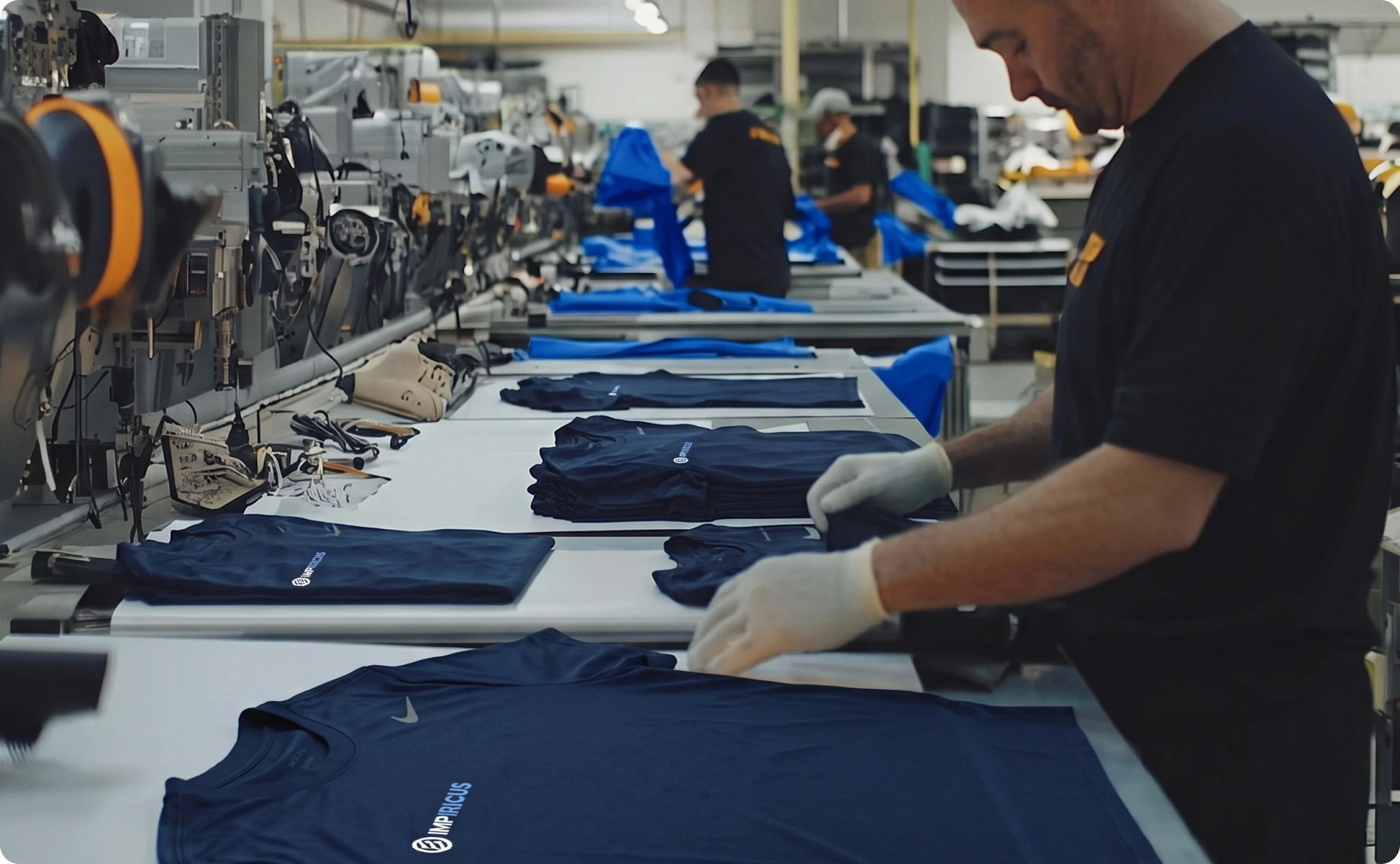
Impiricus used PerkUp to build a branded apparel program designed for repeat ordering. Impiricus then had a consistent look on their swag items across multiple orders, teams, and campaigns without rebuilding the program every time.

Wise

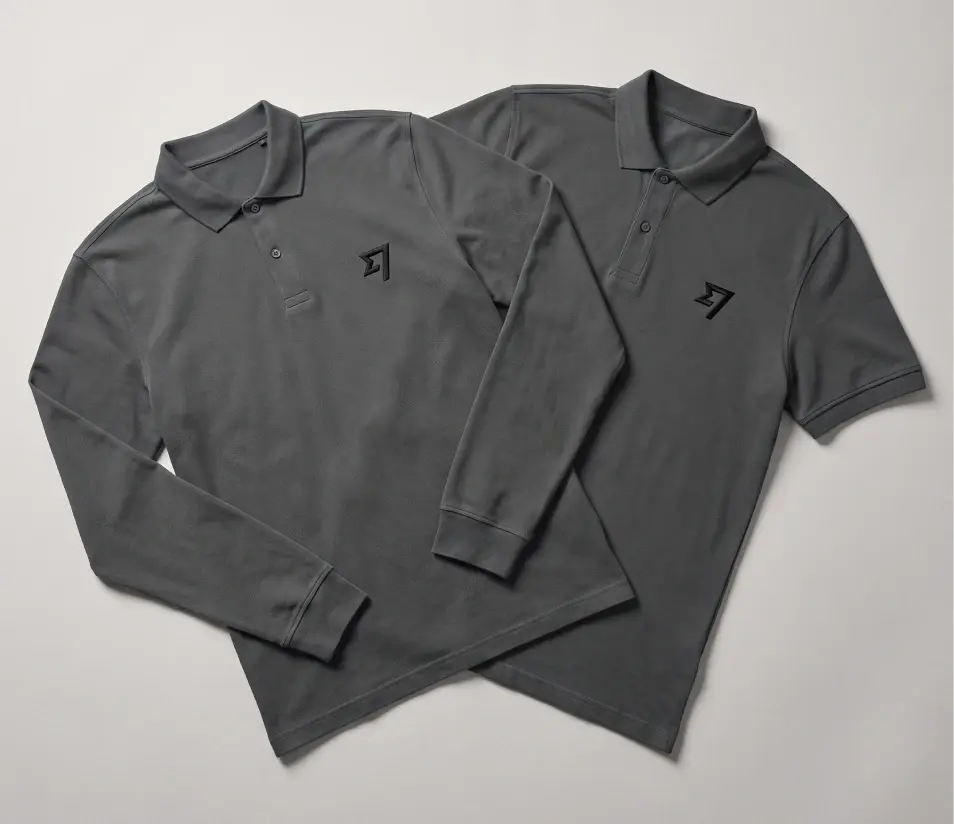
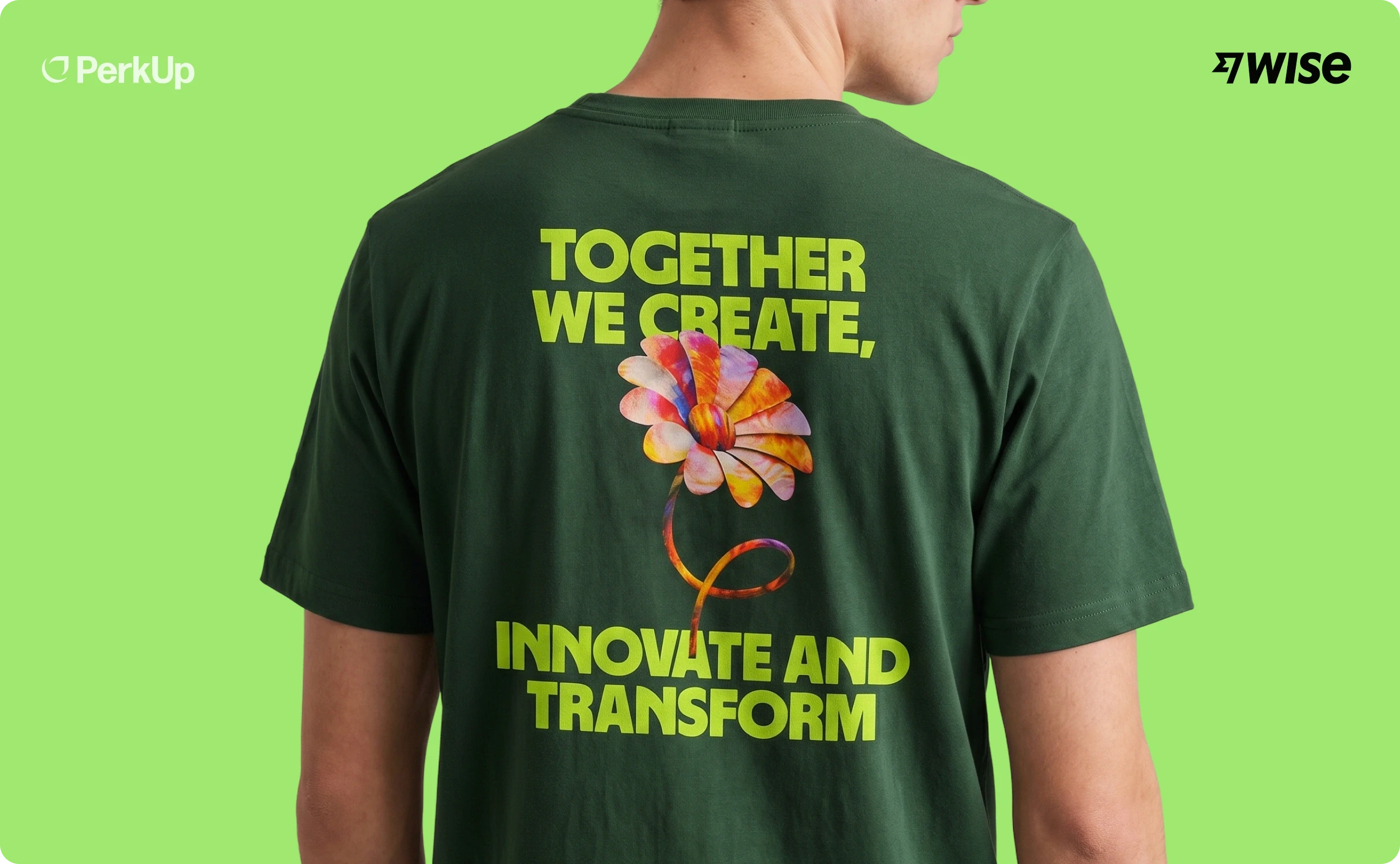
Wise partnered with PerkUp on embroidered internal team apparel built for everyday wear. The swag program focused on apparel that employees would actually wear while working.


Key Takeaways

Good apparel programs are the result of getting a dozen small decisions done right. Choose a fabric people actually want to wear. Match the decoration method to the garment. Give recipients a way to pick their own size. Plan production around the timeline you actually have. Do all of that consistently, and your apparel becomes something your recipients will actually use.

If you'd rather spend your time choosing the apparel than managing production schedules, decoration proofs, and global fulfillment, then work with PerkUp so the platform can handle the rest. From one platform, you can run On Demand orders, bulk programs, swag kits, branded apparel stores, and international fulfillment, all backed by regional warehouses and an in-house design team.


Frequently Asked Questions

What customization options are available for company apparel?

You can customize the garment itself, decoration method, placement, packaging, and even the online ordering experience. Decoration options include embroidery, screen printing, DTG, and DTF, depending on the garment. Additional placements, like sleeve hits, second logos, nape prints, or woven labels, are priced separately from the blank. All of these customization options are available on PerkUp.

What are typical turnaround times for custom branded apparel?

With PerkUp, On Demand apparel typically arrives in about three weeks, since production begins after each order is placed. Bulk apparel generally requires three weeks of production, plus one week for kitting and one week for approvals. International sourcing can add roughly two weeks.

What are the minimum order quantities for branded apparel?

It depends on the production method. On Demand apparel has a 1-unit minimum, making it ideal for one-off orders. Bulk minimums vary by garment and decoration method, but generally begin around 50 units per SKU per warehouse location. PerkUp offers both swag order types.

When should you use On Demand apparel instead of bulk?

Use On Demand when quantities or recipients aren't known in advance, such as onboarding, milestone gifts, or international employee sends. Use bulk when timing and volume are predictable, like conferences, product launches, or annual employee programs. 

Can you put more than one logo on the same garment?

Yes. Multi-logo apparel is common for co-branded events, partnerships, acquisitions, and sponsorships. PerkUp supports multiple brands under one account, and additional decoration placements are priced separately. 

Somewhere in your office, there’s probably a box of company t-shirts that nobody claimed. The reason may be that they’re the wrong size, the cotton is too stiff, it pills too easily, or the logo is so big it’s horrendous. And then you have that quarter-zip that you ordered for your team two years ago that’s still worn around the office, especially during cold days.

So, what’s the difference between those t-shirts and those quarter-zips, when they have the same budget but have completely different outcomes?

The difference lies in a lot of things. After all, buying branded apparel involves the fabric choice, the decoration method, fit, and fulfillment model. In this guide, we’ll break down the decisions that have the biggest impact on apparel swag and how you can apply them in your own swag campaigns.


What counts as swag apparel?

Swag apparel is any branded clothing you give to your employees, customers, event attendees, or partners. These pieces of clothing fall into five categories:

  1. Tees and tops

This is the foundation of most apparel swag programs. They're affordable, easy to size, and common in onboarding kits and recruiting events.

  1. Mid-layers

Hoodies, crewnecks, and quarter-zips belong in this category. These apparel items tend to be the ones that your recipients will likely keep the longest. As such, they’re popular for company anniversaries and holiday sends.

  1. Outerwear

Some examples of outerwear are jackets, fleece, and vests. They’re usually reserved for leadership gifts, sales incentives, customer appreciation, or longer-service awards because of the higher price point.

  1. Collared shirts

It’s easy to lump collared shirts with tees, but they serve a different purpose. Polos and woven button-downs give client-facing teams something more polished than a t-shirt without feeling overly formal.

  1. Bottoms

These include joggers, sweatpants, and shorts, which are most often paired with hoodies or crewnecks to create matching sets for different types of swag campaigns.

One distinction is worth making before we go any further. Uniforms are something people have to wear. Swag is something they choose to wear. That said, that particular difference shapes almost every decision you'll make, from fabric and decoration to fit and brand.

You might also see swag vendors use different names for the same thing: company apparel, branded apparel, corporate apparel, or corporate swag. While yes, the wording changes, the buying decisions don’t.


Why Apparel Outperforms Almost Every Other Swag Category

The biggest advantage of apparel is that people keep wearing it.

Let’s take, for example, the data from ASI's 2026 Ad Impressions Study, where four in five consumers keep a promotional t-shirt for at least a year, and nine in ten wear it at least once a month. If you transform that into advertising numbers, that works out to roughly 3,500 impressions or about ⅓ of a cent per impression! Outerwear performs even better, as it generates around 9,000 impressions over its lifespan while staying under half a cent per impression. That’s cheap but effective advertising.

The value isn't just in the visibility, but also in how your recipients feel about receiving it. PPAI's Product Power 2026 study, which surveyed more than 5,000 U.S. consumers, found that 83% said receiving a branded product made them feel appreciated, while 90% said it improved their perception of the company that gave it to them. In those numbers, apparel consistently ranks among the categories people are most likely to keep and use.

But, of course, there’s also a flip side here. Bad apparel won’t and doesn’t stick around for long. If the fabric feels cheap or the decoration starts cracking after a few washes, then you can bet that they’ll end up in the closet or the trash.

This, then, makes it all the more important to find the best apparel for your swag needs.


How do you choose the right fabric for company apparel?

The quickest way you can judge if the apparel is a good fit for your swag program is to go straight to the spec sheet. There, there will be three things that tell you almost everything you need to know: the fiber content, the way the yarn was spun, and the fabric weight. Everything after that comes down to preference.

In any case, let’s see what you need to know when choosing custom branded apparel for your swag campaigns.

  1. Cotton and how it was spun

Not all cotton feels the same. Open-end cotton is spun quickly in a rotor, making it the most affordable option. It has a rougher hand feel, which is why it dominates budget t-shirts and basic workwear. Ring-spun cotton is twisted into a tighter, smoother yarn, which produces a softer fabric with a cleaner surface for decoration. This makes it the standard for better-quality branded apparel. Combed ring-spun cotton adds another step before spinning by removing the shorter fibers. The result is an even smoother fabric that pills less and generally holds up better over time.

You'll also see singles on some spec sheets. Singles basically measures the fineness of the yarn, meaning the higher the number of singles, the finer the yarn.

One simple rule to ask your swag vendor: if a t-shirt only says “100% cotton” without mentioning how it was spun, ask. 

  1. GSM and ounces

US manufacturers usually list fabric weight in ounces per square yard (oz), while most of the rest of the world uses grams per square meter (GSM). They’re essentially measuring the same thing, just in different units. That said, if you divide GSM by 33.9, you can convert it to ounces.

Here’s a general guide on how GSM/ounces appear on apparel spec sheets:

  • Under 130 GSM (below 3.8 oz) is usually a giveaway-weight apparel, often thin enough to see through

  • 130 to 150 GSM (3.8 to 4.4 oz) is a lightweight tee that's comfortable in warmer weather 

  • 150 to 180 GSM (4.4 to 5.3 oz) is the everyday midweight range where most quality blanks are in

  • 180 to 200 GSM (5.3 to 5.9 oz) means the apparel has more structure and drape without feeling bulky

  • 200 GSM and above (5.9 oz and above) moves into heavyweight territory

A tip: don’t mistake heavier for better. For instance, a 160 GSM combed ring-spun tee will usually outlast and outfeel a 240 GSM open-end tee because fiber quality matters more than weight alone.

  1. Blends, fleece, and performance fabrics

Cotton isn't always the right choice. For one, a 50/50 cotton-poly blend shrinks less, wrinkles less, and takes screen printing well. This actually makes it one of the most common choices for event apparel. Tri-blends, on the other hand, combine cotton, polyester, and rayon for a softer drape that feels closer to retail clothing than traditional promotional apparel. Performance polyester is built for moisture-wicking and athletic use, although it needs decoration methods designed specifically for synthetic fabrics. For hoodies, crewnecks, and joggers, fleece typically ranges from 8 to 13 oz. Around 8 oz feels like everyday loungewear, while 10 oz and above start to feel closer to premium retail apparel.

Specs to check before approving a sample

With the 3 things mentioned above, here’s what you need to check before approving a sample for a company apparel item:

  1. Fabric weight - Check the GSM or ounce weight for the exact color you're ordering, since heather colorways often use different blends and weights.

  2. Spinning method and singles - Combed ring-spun cotton in the 30s or 32s is a practical quality floor for a t-shirt people will actually keep wearing.

  3. Side-seamed vs. tubular construction - Side-seamed garments hold their shape better through repeated washing, while tubular garments are more likely to twist over time.

  4. Pre-shrunk or garment-dyed fabric - Untreated cotton can shrink 5% to 10% after the first hot wash, which is close to a full size on a T-shirt. Pre-shrunk and garment-dyed fabrics usually keep shrinkage to just a couple of percent, with most of that happening during the first few washes.

  5. Size range - Don’t opt for a style that only runs from S through XL, as you may have unknowingly already excluded a part of your team.

As a point of reference for a good choice for an apparel item, BELLA+CANVAS lists its popular 3001 tee at 4.2 oz, made from 100% Airlume combed and ring-spun cotton, 32 singles, pre-shrunk, side-seamed, and available from XS through 4XL.


What People Actually Want to Wear Now

Company apparel has shifted toward retail. While the lightweight promotional tee with a large logo across the chest isn’t completely gone, it's no longer what most people will wear. Employees want apparel they'd wear outside of work, and companies are starting to order accordingly.

Here are five trends that stand out:

  • Heavyweight fabrics - The biggest apparel trend for 2026 is people looking for heavyweight fabrics, with 62% of buyers planning to try heavier-weight garments.

  • Garment-dyed and washed colors - Half of buyers want to move away from bright basics in favor of softer, lived-in colors.

  • Boxy, drop-shoulder fits - 46% now prefer relaxed silhouettes over the slimmer cuts that dominated the last decade.

  • Smaller logos - Tone-on-tone embroidery and thread matched to the garment have become the standard for employee apparel, while event swag still makes room for larger front graphics.

  • Styles that work outside the office - Quarter-zips and premium hoodies continue to gain ground because people can wear them on a client call, to the grocery store, or over the weekend.


Tips To Get Apparel Sizing Right

If you don’t want to waste your apparel budget, then don’t guess sizes. For example, a size run that stops at XL isn’t covering the average population, let alone your global team. If your order doesn’t account for the average waist circumference of 40.6 inches for men and 38.5 inches for women aged 20 and over in the US, then someone in your recipient list will be left out.

If you haven’t collected sizes yet, you can start with a working distribution and adjust it based on your audience and region:

  • Small: 10%

  • Medium: 30%

  • Large: 35%

  • XL: 20%

  • XXL: 5%

Treat that as a starting point for a first order, not a replacement for collecting real sizes.

There are also a few habits that can make a much bigger difference than trying to predict the perfect ratio:

  • Order XS through 4XL whenever the style offers it

  • Unisex is usually a good fit for a large recipient group

  • Publish chest and body-length measurements alongside letter sizes, since an XL can vary significantly between brands

  • Collect sizes during onboarding or event registration, not after the apparel has already been ordered

  • Add a small buffer at both ends of the size range

The best long-term solution is to stop guessing altogether. For this, you can either opt for a swag store or order On Demand. A company swag store lets each recipient choose their own size and style before anything is produced. With On Demand swag, every order is made individually with a 1-unit minimum, so you’re not left holding forty unworn medium T-shirts. What’s more, that 1-unit minimum is what actually solves the sizing problem. Nothing gets produced until someone tells you what they need, which means no size curve to forecast and no leftover inventory. For teams spread across several countries, where sizing conventions differ market to market, it removes the guesswork entirely.


Which decoration method should you use for apparel?

Here's the short version of which method suits which garment.

  1. Screen printing

The most cost-effective option for large runs, with the price per garment dropping quickly once you're ordering 50 or more.

Best used on: heavyweight cotton tees, cotton hoodies, cotton crewnecks

  1. Embroidery

Priced by stitch count rather than color count, and the longest-lasting of the four. Tone-on-tone thread has become the standard for employee apparel.

Best used on: pique polos, quarter-zips, jackets and softshells, vests, joggers

  1. Direct to garment (DTG)

No screens, no setup fees, and no minimums, so a full-color design costs the same as a one-color logo. Best on cotton, less consistent on polyester and heavier blends.

Best used on: 100% cotton tees, cotton tanks, cotton long-sleeve tees, cotton crewnecks, cotton hoodies

  1. Direct to film (DTF)

Works on cotton, polyester, and blends equally, which makes it the default for performance apparel.

Best used on: performance tees, performance polos, poly quarter-zips, athletic shorts, blended fleece hoodies

For a deeper comparison, PerkUp's guide to customization methods covers embroidery, screen printing, DTG, DTF, and the situations where each should be used.


How should you design apparel people actually want to wear?

Most companies choose the garment first and worry about the artwork later. It usually works better the other way around because the color, fabric, and decoration method all affect what your design can actually do.

  1. Tone-on-tone

Tone-on-tone decoration matches the thread or ink to the garment color. The logo is easy to spot up close, but fades into the garment from across the room. It's become the default look for employee apparel as of late because it feels more like retail than promotional swag. 

  1. Start with the garment color

Garment-dyed and washed colors already have a softer look, so low-contrast artwork can disappear completely on heathers and faded fabrics. Dark garments usually require a white underbase when screen printed, which adds another screen and another production pass.

  1. Get the artwork production-ready

The decoration method also determines how your artwork should be prepared. Screen printing and cut vinyl require vector artwork, usually supplied as an AI, EPS, or SVG file. Embroidery needs the artwork digitized into a DST file before production begins. That's usually where fine lines, small text, and intricate details start disappearing if the original logo wasn't designed for stitching. DTG and DTF are priced by print size rather than color count, so it's usually smarter to design within the intended print area.


Where should the logo go?

Placement matters almost as much as the decoration method. A standard left-chest logo usually measures 2.5 to 4 inches wide by 1 to 2 inches tall, and it's the default for company apparel because it looks balanced on almost every garment. 

Here's where to put your logo on apparel, and what each placement is best suited for:

  1. Left chest: The standard choice for company apparel. It’s usually around 2.5 to 4 inches wide by 1 to 2 inches tall. It stays balanced across different garments and body types.

  2. Full front: Best for event apparel and full visibility.

  3. Sleeve: This placement works especially well alongside a left-chest logo.

  4. Nape print or custom inside label: These placements are barely visible when worn.

  5. Bottoms: Logos typically sit on a jogger’s or sweatpants’ left hip, run vertically down the leg, or appear as a small detail on the back pocket.

Sleeve hits, nape prints, and inside labels are relatively inexpensive upgrades, though each additional placement incurs its own decoration charge.


Choosing Apparel Brands For A Swag Program

The brand on the tag matters more than you might expect. In Custom Ink's 2026 Swag Trends Survey, 91% of respondents said their team feels more valued receiving a recognized retail brand than a generic private-label item. That doesn't mean every program needs Patagonia, though. The goal is to match your brand to your audience, your budget, and the occasion. 

Some apparel brands by tier

  1. Entry: Gildan and BELLA+CANVAS 

  2. A step up: AS Colour and Stanley/Stella

  3. Mid-tier: Eddie Bauer, Mercer+Mettle, and Port Authority

  4. Premium: Nike, Adidas, The North Face, and Carhartt 

  5. Executive: Patagonia, Peter Millar, TravisMathew, and Brooks Brothers

The ultimate rule of thumb here is you need to build your swag program around the occasion and your recipients. 


 Shipping Swag Apparel to Global Teams

There are a couple of things you should know about when you’re sending swag apparel to your global teams:

  1. Use the same decoration method across every region. Mixing DTG in one country with screen printing in another produces noticeably different-looking garments.

  2. Approve one physical sample before production. Once the sample is right, repeat that specification everywhere.

  3. Produce close to your recipient. Shipping every order from the US adds unnecessary customs delays and increases the chance of lost shipments.

  4. Ship DDP whenever possible. Prepaid duties mean your recipient won’t have to pay an unexpected customs bill.

  5. Check brand availability before approving a style. More international apparel orders fall apart because of brand restrictions than because of price.


What changes when you ship apparel to different countries?

The five tips above are general rules or advice you should follow. However, there are specific changes when it comes to different countries.

  • The UK and Europe - Apparel generally clears customs without much trouble, but clearance still adds time to the delivery. We cover that in more detail in our guide to sending swag to the UK.

  • Canada - Canadian recipients tend to respond well to domestically produced apparel, and heavier layers outperform lightweight styles for much of the year. Our guide to shipping swag to Canada covers the full details of this.

  • Mexico - Local suppliers already handle apparel well in Mexico, so producing within the country is usually faster and more cost-effective than shipping garments across the border. Check out our guide to shipping swag to Mexico to see what else you need to learn about sending swag to this country.

  • India - New apparel isn't restricted, but the import costs add up quickly. India has no de minimis threshold, so even a single hoodie can be assessed for duties and taxes. Our guide to sending swag to India breaks it down further.

  • Australia and New Zealand - Many suppliers don't ship DDP into these markets, so orders typically route through an Australian warehouse instead. More on that in our guide to shipping swag to Australia.

Wherever your apparel is headed, shipping DDP or sourcing and producing locally wherever possible are still the easiest ways to avoid customs surprises and delays.


Apparel Production Timelines and Order Types

Every custom apparel order runs on one of two production timelines: On Demand and bulk.

On Demand swag covers individual items as it has a 1-unit minimum order. Each apparel item is produced after someone places an order and typically arrives in about three weeks from order to delivery. Nothing is produced ahead of time or left sitting in a warehouse, so there’s no inventory risk and no pile of unsold sizes when the program ends. That makes On Demand a natural fit when your recipient list or timing is still up in the air. 

Bulk swag handles larger production runs. Plan on roughly five to six weeks before the first shipment leaves the warehouse: three weeks for production, one week for kitting, and one week for approvals. Apparel items in bulk are produced ahead of time, stored in a warehouse, and then shipped within a few business days whenever someone needs one.


Apparel Dos and Don’ts

If you only remember one thing from this guide, make it this: the dos and don’ts of ordering apparel swag.

Do

  • Read the spec sheet before the price. Fabric weight, spinning method, construction, and size range tell you far more about how a garment will wear.

  • Choose the decoration method first. Your artwork quickly narrows the garments that will work well, and changing direction after you've chosen a blank is expensive.

  • Let your recipients choose their own size. A swag store or On Demand ordering can help you avoid wasted apparel inventory.

  • Check brand availability before approving a style. Make sure every destination on your list can actually receive the apparel items.

  • Approve one physical sample and stick to it. Replicating the same approved specification across every region is the easiest way to keep a global apparel program consistent.

Don't

  • Don't use event artwork on employee apparel. A logo designed to stand out across a trade show floor rarely becomes something people want to wear on the weekend.

  • Don't plan apparel for a last-minute global send. Sizes are usually what slow international programs down. When time is tight, non-sized swag like drinkware is often the safer choice.

  • Don't buy bulk for people you can't name yet. Unsold inventory ties up warehouse space and budget.

  • Don't promise delivery dates before approvals finish. Every proof round adds 2 to 4 business days (which can still vary), and cross-region sourcing can add roughly two more weeks.

  • Don't ship Deliver Duty Unpaid unless you have to. Unless you absolutely can’t ship DDP, then don’t let your recipients pay for customs and other fees.


How PerkUp Runs Apparel for Global Teams

Most apparel programs don't run on a single order type. You may need t-shirts for your onboarding or a premium Peter Millar for your executives. Ordering from different suppliers can only cause you headaches and missed deadlines. 

That’s why working with a swag management platform like PerkUp is especially important when it comes to swag apparel campaigns. From one platform, you can run bulk swag, On Demand swag, event swag, swag stores, swag kits, and even gift cards, using whichever approach fits your budget, your recipients, and the occasion.

That flexibility is also applicable to sourcing. PerkUp has more than 1,000 On Demand items with a 1-unit minimum, so you can send one hoodie in one size without committing to a larger run. Your recipients get to choose the size and style that works for them. And since PerkUp produces the On Demand swag apparel item after it’s ordered, and there’s no inventory sitting around afterward. Plus, its bulk catalog has thousands of options for larger programs. And if apparel isn't the right fit, PerkUp’s catalog includes 5,000+ gift cards, too.

PerkUp operates warehouses in the US, Canada, Mexico, the UK, Europe, India, China, and Australia, reaching more than 65 countries with duties prepaid wherever possible. Additionally, the platform also has an in-house design team that creates mockups, reviews artwork, and advises on decoration methods at no additional cost, so you don’t have to figure out decoration methods on your own. And because your recipients can also order through a branded swag store (if that’s what you’ll go for), they can choose their own size, fit, and style within the budget you set, which dramatically reduces sizing mistakes and leftover inventory.

PerkUp also has 200+ integrations, allowing you to automate your milestone gifting so that you can send apparel items or any other swag items to your recipients on their birthdays, work anniversaries, or onboarding.

Apparel programs PerkUp has built

Microsoft

PerkUp produced premium custom letterman jackets for Microsoft. Between the materials, decoration, and presentation, the program focused on creating something recipients would keep and use often.

Impiricus

Impiricus used PerkUp to build a branded apparel program designed for repeat ordering. Impiricus then had a consistent look on their swag items across multiple orders, teams, and campaigns without rebuilding the program every time.

Wise

Wise partnered with PerkUp on embroidered internal team apparel built for everyday wear. The swag program focused on apparel that employees would actually wear while working.


Key Takeaways

Good apparel programs are the result of getting a dozen small decisions done right. Choose a fabric people actually want to wear. Match the decoration method to the garment. Give recipients a way to pick their own size. Plan production around the timeline you actually have. Do all of that consistently, and your apparel becomes something your recipients will actually use.

If you'd rather spend your time choosing the apparel than managing production schedules, decoration proofs, and global fulfillment, then work with PerkUp so the platform can handle the rest. From one platform, you can run On Demand orders, bulk programs, swag kits, branded apparel stores, and international fulfillment, all backed by regional warehouses and an in-house design team.


Frequently Asked Questions

What customization options are available for company apparel?

You can customize the garment itself, decoration method, placement, packaging, and even the online ordering experience. Decoration options include embroidery, screen printing, DTG, and DTF, depending on the garment. Additional placements, like sleeve hits, second logos, nape prints, or woven labels, are priced separately from the blank. All of these customization options are available on PerkUp.

What are typical turnaround times for custom branded apparel?

With PerkUp, On Demand apparel typically arrives in about three weeks, since production begins after each order is placed. Bulk apparel generally requires three weeks of production, plus one week for kitting and one week for approvals. International sourcing can add roughly two weeks.

What are the minimum order quantities for branded apparel?

It depends on the production method. On Demand apparel has a 1-unit minimum, making it ideal for one-off orders. Bulk minimums vary by garment and decoration method, but generally begin around 50 units per SKU per warehouse location. PerkUp offers both swag order types.

When should you use On Demand apparel instead of bulk?

Use On Demand when quantities or recipients aren't known in advance, such as onboarding, milestone gifts, or international employee sends. Use bulk when timing and volume are predictable, like conferences, product launches, or annual employee programs. 

Can you put more than one logo on the same garment?

Yes. Multi-logo apparel is common for co-branded events, partnerships, acquisitions, and sponsorships. PerkUp supports multiple brands under one account, and additional decoration placements are priced separately. 

Somewhere in your office, there’s probably a box of company t-shirts that nobody claimed. The reason may be that they’re the wrong size, the cotton is too stiff, it pills too easily, or the logo is so big it’s horrendous. And then you have that quarter-zip that you ordered for your team two years ago that’s still worn around the office, especially during cold days.

So, what’s the difference between those t-shirts and those quarter-zips, when they have the same budget but have completely different outcomes?

The difference lies in a lot of things. After all, buying branded apparel involves the fabric choice, the decoration method, fit, and fulfillment model. In this guide, we’ll break down the decisions that have the biggest impact on apparel swag and how you can apply them in your own swag campaigns.


What counts as swag apparel?

Swag apparel is any branded clothing you give to your employees, customers, event attendees, or partners. These pieces of clothing fall into five categories:

  1. Tees and tops

This is the foundation of most apparel swag programs. They're affordable, easy to size, and common in onboarding kits and recruiting events.

  1. Mid-layers

Hoodies, crewnecks, and quarter-zips belong in this category. These apparel items tend to be the ones that your recipients will likely keep the longest. As such, they’re popular for company anniversaries and holiday sends.

  1. Outerwear

Some examples of outerwear are jackets, fleece, and vests. They’re usually reserved for leadership gifts, sales incentives, customer appreciation, or longer-service awards because of the higher price point.

  1. Collared shirts

It’s easy to lump collared shirts with tees, but they serve a different purpose. Polos and woven button-downs give client-facing teams something more polished than a t-shirt without feeling overly formal.

  1. Bottoms

These include joggers, sweatpants, and shorts, which are most often paired with hoodies or crewnecks to create matching sets for different types of swag campaigns.

One distinction is worth making before we go any further. Uniforms are something people have to wear. Swag is something they choose to wear. That said, that particular difference shapes almost every decision you'll make, from fabric and decoration to fit and brand.

You might also see swag vendors use different names for the same thing: company apparel, branded apparel, corporate apparel, or corporate swag. While yes, the wording changes, the buying decisions don’t.


Why Apparel Outperforms Almost Every Other Swag Category

The biggest advantage of apparel is that people keep wearing it.

Let’s take, for example, the data from ASI's 2026 Ad Impressions Study, where four in five consumers keep a promotional t-shirt for at least a year, and nine in ten wear it at least once a month. If you transform that into advertising numbers, that works out to roughly 3,500 impressions or about ⅓ of a cent per impression! Outerwear performs even better, as it generates around 9,000 impressions over its lifespan while staying under half a cent per impression. That’s cheap but effective advertising.

The value isn't just in the visibility, but also in how your recipients feel about receiving it. PPAI's Product Power 2026 study, which surveyed more than 5,000 U.S. consumers, found that 83% said receiving a branded product made them feel appreciated, while 90% said it improved their perception of the company that gave it to them. In those numbers, apparel consistently ranks among the categories people are most likely to keep and use.

But, of course, there’s also a flip side here. Bad apparel won’t and doesn’t stick around for long. If the fabric feels cheap or the decoration starts cracking after a few washes, then you can bet that they’ll end up in the closet or the trash.

This, then, makes it all the more important to find the best apparel for your swag needs.


How do you choose the right fabric for company apparel?

The quickest way you can judge if the apparel is a good fit for your swag program is to go straight to the spec sheet. There, there will be three things that tell you almost everything you need to know: the fiber content, the way the yarn was spun, and the fabric weight. Everything after that comes down to preference.

In any case, let’s see what you need to know when choosing custom branded apparel for your swag campaigns.

  1. Cotton and how it was spun

Not all cotton feels the same. Open-end cotton is spun quickly in a rotor, making it the most affordable option. It has a rougher hand feel, which is why it dominates budget t-shirts and basic workwear. Ring-spun cotton is twisted into a tighter, smoother yarn, which produces a softer fabric with a cleaner surface for decoration. This makes it the standard for better-quality branded apparel. Combed ring-spun cotton adds another step before spinning by removing the shorter fibers. The result is an even smoother fabric that pills less and generally holds up better over time.

You'll also see singles on some spec sheets. Singles basically measures the fineness of the yarn, meaning the higher the number of singles, the finer the yarn.

One simple rule to ask your swag vendor: if a t-shirt only says “100% cotton” without mentioning how it was spun, ask. 

  1. GSM and ounces

US manufacturers usually list fabric weight in ounces per square yard (oz), while most of the rest of the world uses grams per square meter (GSM). They’re essentially measuring the same thing, just in different units. That said, if you divide GSM by 33.9, you can convert it to ounces.

Here’s a general guide on how GSM/ounces appear on apparel spec sheets:

  • Under 130 GSM (below 3.8 oz) is usually a giveaway-weight apparel, often thin enough to see through

  • 130 to 150 GSM (3.8 to 4.4 oz) is a lightweight tee that's comfortable in warmer weather 

  • 150 to 180 GSM (4.4 to 5.3 oz) is the everyday midweight range where most quality blanks are in

  • 180 to 200 GSM (5.3 to 5.9 oz) means the apparel has more structure and drape without feeling bulky

  • 200 GSM and above (5.9 oz and above) moves into heavyweight territory

A tip: don’t mistake heavier for better. For instance, a 160 GSM combed ring-spun tee will usually outlast and outfeel a 240 GSM open-end tee because fiber quality matters more than weight alone.

  1. Blends, fleece, and performance fabrics

Cotton isn't always the right choice. For one, a 50/50 cotton-poly blend shrinks less, wrinkles less, and takes screen printing well. This actually makes it one of the most common choices for event apparel. Tri-blends, on the other hand, combine cotton, polyester, and rayon for a softer drape that feels closer to retail clothing than traditional promotional apparel. Performance polyester is built for moisture-wicking and athletic use, although it needs decoration methods designed specifically for synthetic fabrics. For hoodies, crewnecks, and joggers, fleece typically ranges from 8 to 13 oz. Around 8 oz feels like everyday loungewear, while 10 oz and above start to feel closer to premium retail apparel.

Specs to check before approving a sample

With the 3 things mentioned above, here’s what you need to check before approving a sample for a company apparel item:

  1. Fabric weight - Check the GSM or ounce weight for the exact color you're ordering, since heather colorways often use different blends and weights.

  2. Spinning method and singles - Combed ring-spun cotton in the 30s or 32s is a practical quality floor for a t-shirt people will actually keep wearing.

  3. Side-seamed vs. tubular construction - Side-seamed garments hold their shape better through repeated washing, while tubular garments are more likely to twist over time.

  4. Pre-shrunk or garment-dyed fabric - Untreated cotton can shrink 5% to 10% after the first hot wash, which is close to a full size on a T-shirt. Pre-shrunk and garment-dyed fabrics usually keep shrinkage to just a couple of percent, with most of that happening during the first few washes.

  5. Size range - Don’t opt for a style that only runs from S through XL, as you may have unknowingly already excluded a part of your team.

As a point of reference for a good choice for an apparel item, BELLA+CANVAS lists its popular 3001 tee at 4.2 oz, made from 100% Airlume combed and ring-spun cotton, 32 singles, pre-shrunk, side-seamed, and available from XS through 4XL.


What People Actually Want to Wear Now

Company apparel has shifted toward retail. While the lightweight promotional tee with a large logo across the chest isn’t completely gone, it's no longer what most people will wear. Employees want apparel they'd wear outside of work, and companies are starting to order accordingly.

Here are five trends that stand out:

  • Heavyweight fabrics - The biggest apparel trend for 2026 is people looking for heavyweight fabrics, with 62% of buyers planning to try heavier-weight garments.

  • Garment-dyed and washed colors - Half of buyers want to move away from bright basics in favor of softer, lived-in colors.

  • Boxy, drop-shoulder fits - 46% now prefer relaxed silhouettes over the slimmer cuts that dominated the last decade.

  • Smaller logos - Tone-on-tone embroidery and thread matched to the garment have become the standard for employee apparel, while event swag still makes room for larger front graphics.

  • Styles that work outside the office - Quarter-zips and premium hoodies continue to gain ground because people can wear them on a client call, to the grocery store, or over the weekend.


Tips To Get Apparel Sizing Right

If you don’t want to waste your apparel budget, then don’t guess sizes. For example, a size run that stops at XL isn’t covering the average population, let alone your global team. If your order doesn’t account for the average waist circumference of 40.6 inches for men and 38.5 inches for women aged 20 and over in the US, then someone in your recipient list will be left out.

If you haven’t collected sizes yet, you can start with a working distribution and adjust it based on your audience and region:

  • Small: 10%

  • Medium: 30%

  • Large: 35%

  • XL: 20%

  • XXL: 5%

Treat that as a starting point for a first order, not a replacement for collecting real sizes.

There are also a few habits that can make a much bigger difference than trying to predict the perfect ratio:

  • Order XS through 4XL whenever the style offers it

  • Unisex is usually a good fit for a large recipient group

  • Publish chest and body-length measurements alongside letter sizes, since an XL can vary significantly between brands

  • Collect sizes during onboarding or event registration, not after the apparel has already been ordered

  • Add a small buffer at both ends of the size range

The best long-term solution is to stop guessing altogether. For this, you can either opt for a swag store or order On Demand. A company swag store lets each recipient choose their own size and style before anything is produced. With On Demand swag, every order is made individually with a 1-unit minimum, so you’re not left holding forty unworn medium T-shirts. What’s more, that 1-unit minimum is what actually solves the sizing problem. Nothing gets produced until someone tells you what they need, which means no size curve to forecast and no leftover inventory. For teams spread across several countries, where sizing conventions differ market to market, it removes the guesswork entirely.


Which decoration method should you use for apparel?

Here's the short version of which method suits which garment.
  1. Screen printing

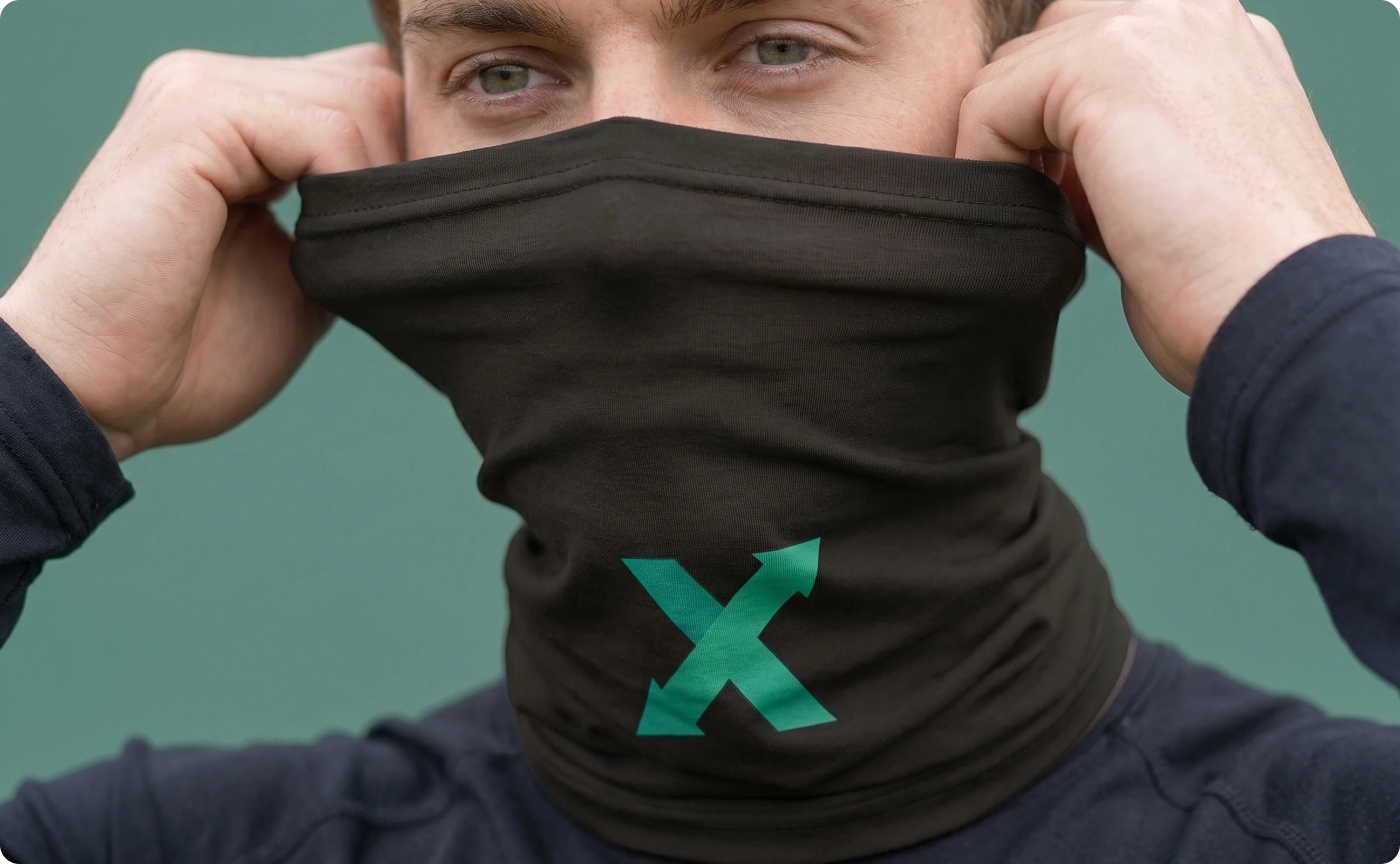
The most cost-effective option for large runs, with the price per garment dropping quickly once you're ordering 50 or more.

Best used on: heavyweight cotton tees, cotton hoodies, cotton crewnecks
  1. Embroidery

Priced by stitch count rather than color count, and the longest-lasting of the four. Tone-on-tone thread has become the standard for employee apparel.

Best used on: pique polos, quarter-zips, jackets and softshells, vests, joggers
  1. Direct to garment (DTG)

No screens, no setup fees, and no minimums, so a full-color design costs the same as a one-color logo. Best on cotton, less consistent on polyester and heavier blends.

Best used on: 100% cotton tees, cotton tanks, cotton long-sleeve tees, cotton crewnecks, cotton hoodies
  1. Direct to film (DTF)

Works on cotton, polyester, and blends equally, which makes it the default for performance apparel.

Best used on: performance tees, performance polos, poly quarter-zips, athletic shorts, blended fleece hoodies

For a deeper comparison, PerkUp's guide to customization methods covers embroidery, screen printing, DTG, DTF, and the situations where each should be used.


How should you design apparel people actually want to wear?

Most companies choose the garment first and worry about the artwork later. It usually works better the other way around because the color, fabric, and decoration method all affect what your design can actually do.

  1. Tone-on-tone

Tone-on-tone decoration matches the thread or ink to the garment color. The logo is easy to spot up close, but fades into the garment from across the room. It's become the default look for employee apparel as of late because it feels more like retail than promotional swag. 

  1. Start with the garment color

Garment-dyed and washed colors already have a softer look, so low-contrast artwork can disappear completely on heathers and faded fabrics. Dark garments usually require a white underbase when screen printed, which adds another screen and another production pass.

  1. Get the artwork production-ready

The decoration method also determines how your artwork should be prepared. Screen printing and cut vinyl require vector artwork, usually supplied as an AI, EPS, or SVG file. Embroidery needs the artwork digitized into a DST file before production begins. That's usually where fine lines, small text, and intricate details start disappearing if the original logo wasn't designed for stitching. DTG and DTF are priced by print size rather than color count, so it's usually smarter to design within the intended print area.


Where should the logo go?

Placement matters almost as much as the decoration method. A standard left-chest logo usually measures 2.5 to 4 inches wide by 1 to 2 inches tall, and it's the default for company apparel because it looks balanced on almost every garment. 

Here's where to put your logo on apparel, and what each placement is best suited for:

  1. Left chest: The standard choice for company apparel. It’s usually around 2.5 to 4 inches wide by 1 to 2 inches tall. It stays balanced across different garments and body types.

  2. Full front: Best for event apparel and full visibility.

  3. Sleeve: This placement works especially well alongside a left-chest logo.

  4. Nape print or custom inside label: These placements are barely visible when worn.

  5. Bottoms: Logos typically sit on a jogger’s or sweatpants’ left hip, run vertically down the leg, or appear as a small detail on the back pocket.

Sleeve hits, nape prints, and inside labels are relatively inexpensive upgrades, though each additional placement incurs its own decoration charge.


Choosing Apparel Brands For A Swag Program

The brand on the tag matters more than you might expect. In Custom Ink's 2026 Swag Trends Survey, 91% of respondents said their team feels more valued receiving a recognized retail brand than a generic private-label item. That doesn't mean every program needs Patagonia, though. The goal is to match your brand to your audience, your budget, and the occasion. 
Some apparel brands by tier

  1. Entry: Gildan and BELLA+CANVAS 

  2. A step up: AS Colour and Stanley/Stella

  3. Mid-tier: Eddie Bauer, Mercer+Mettle, and Port Authority

  4. Premium: Nike, Adidas, The North Face, and Carhartt 

  5. Executive: Patagonia, Peter Millar, TravisMathew, and Brooks Brothers

The ultimate rule of thumb here is you need to build your swag program around the occasion and your recipients. 


 Shipping Swag Apparel to Global Teams

There are a couple of things you should know about when you’re sending swag apparel to your global teams:

  1. Use the same decoration method across every region. Mixing DTG in one country with screen printing in another produces noticeably different-looking garments.

  2. Approve one physical sample before production. Once the sample is right, repeat that specification everywhere.

  3. Produce close to your recipient. Shipping every order from the US adds unnecessary customs delays and increases the chance of lost shipments.

  4. Ship DDP whenever possible. Prepaid duties mean your recipient won’t have to pay an unexpected customs bill.

  5. Check brand availability before approving a style. More international apparel orders fall apart because of brand restrictions than because of price.
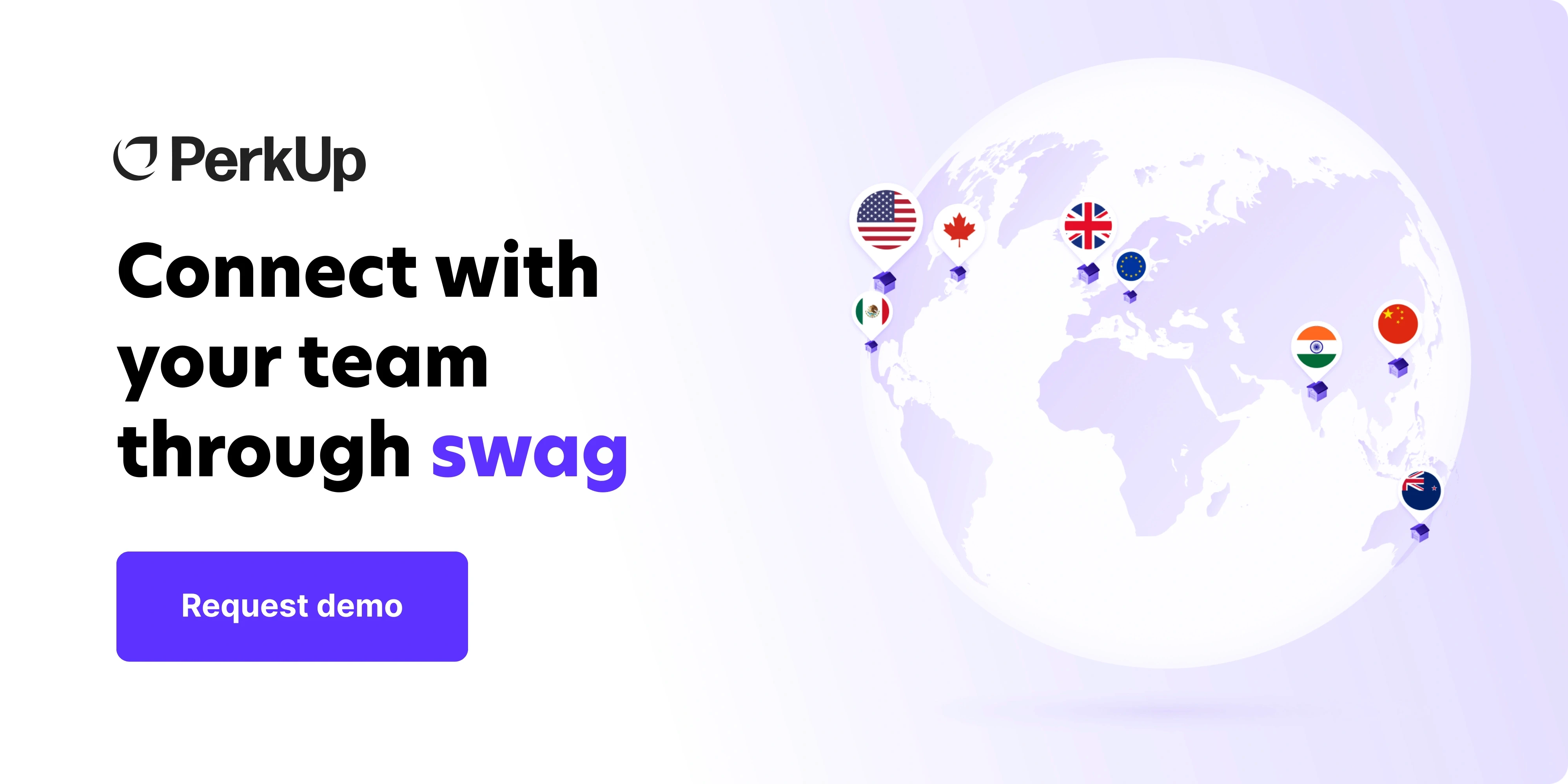


What changes when you ship apparel to different countries?

The five tips above are general rules or advice you should follow. However, there are specific changes when it comes to different countries.

  • The UK and Europe - Apparel generally clears customs without much trouble, but clearance still adds time to the delivery. We cover that in more detail in our guide to sending swag to the UK.

  • Canada - Canadian recipients tend to respond well to domestically produced apparel, and heavier layers outperform lightweight styles for much of the year. Our guide to shipping swag to Canada covers the full details of this.

  • Mexico - Local suppliers already handle apparel well in Mexico, so producing within the country is usually faster and more cost-effective than shipping garments across the border. Check out our guide to shipping swag to Mexico to see what else you need to learn about sending swag to this country.

  • India - New apparel isn't restricted, but the import costs add up quickly. India has no de minimis threshold, so even a single hoodie can be assessed for duties and taxes. Our guide to sending swag to India breaks it down further.

  • Australia and New Zealand - Many suppliers don't ship DDP into these markets, so orders typically route through an Australian warehouse instead. More on that in our guide to shipping swag to Australia.

Wherever your apparel is headed, shipping DDP or sourcing and producing locally wherever possible are still the easiest ways to avoid customs surprises and delays.


Apparel Production Timelines and Order Types

Every custom apparel order runs on one of two production timelines: On Demand and bulk.
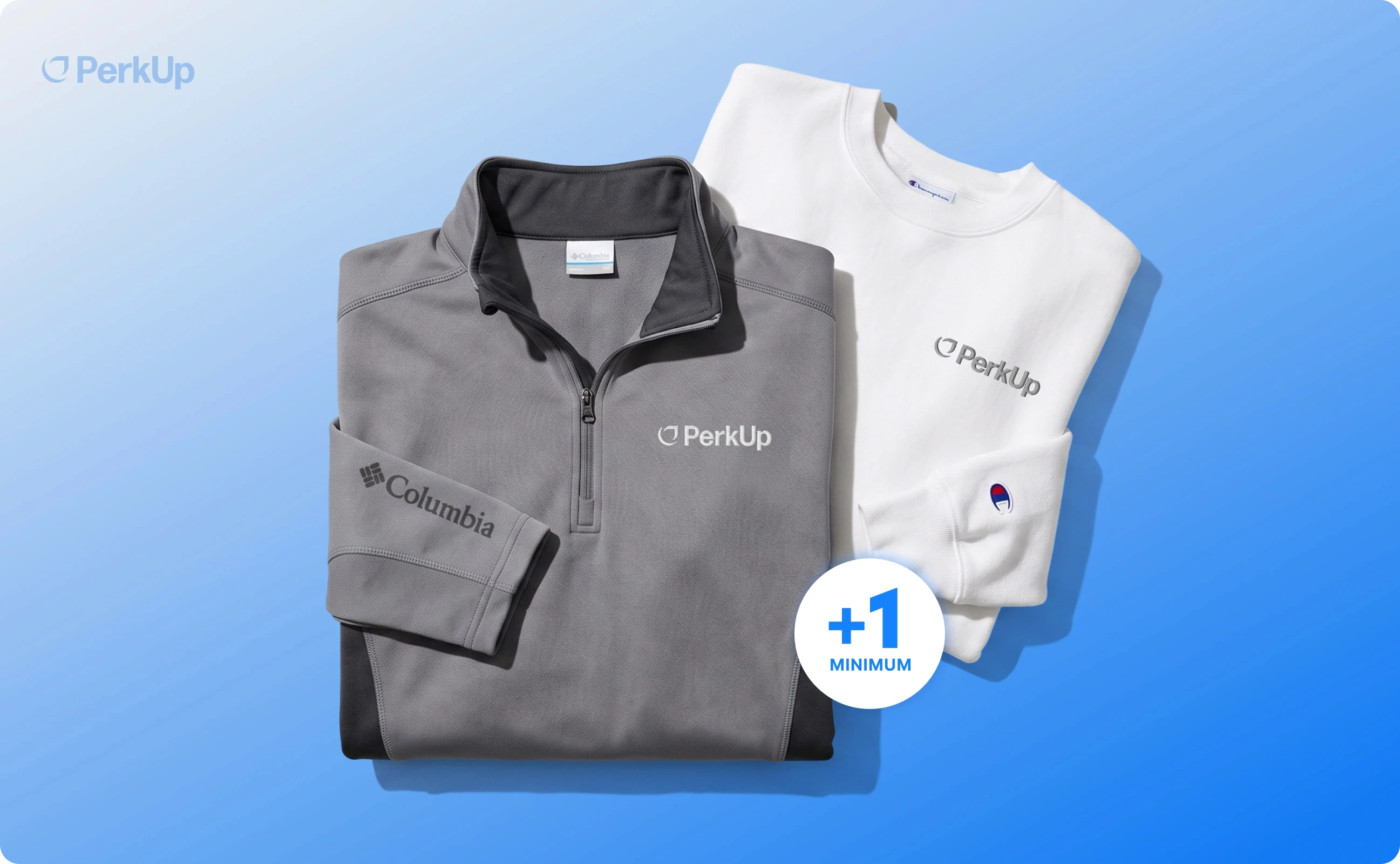
On Demand swag covers individual items as it has a 1-unit minimum order. Each apparel item is produced after someone places an order and typically arrives in about three weeks from order to delivery. Nothing is produced ahead of time or left sitting in a warehouse, so there’s no inventory risk and no pile of unsold sizes when the program ends. That makes On Demand a natural fit when your recipient list or timing is still up in the air. 
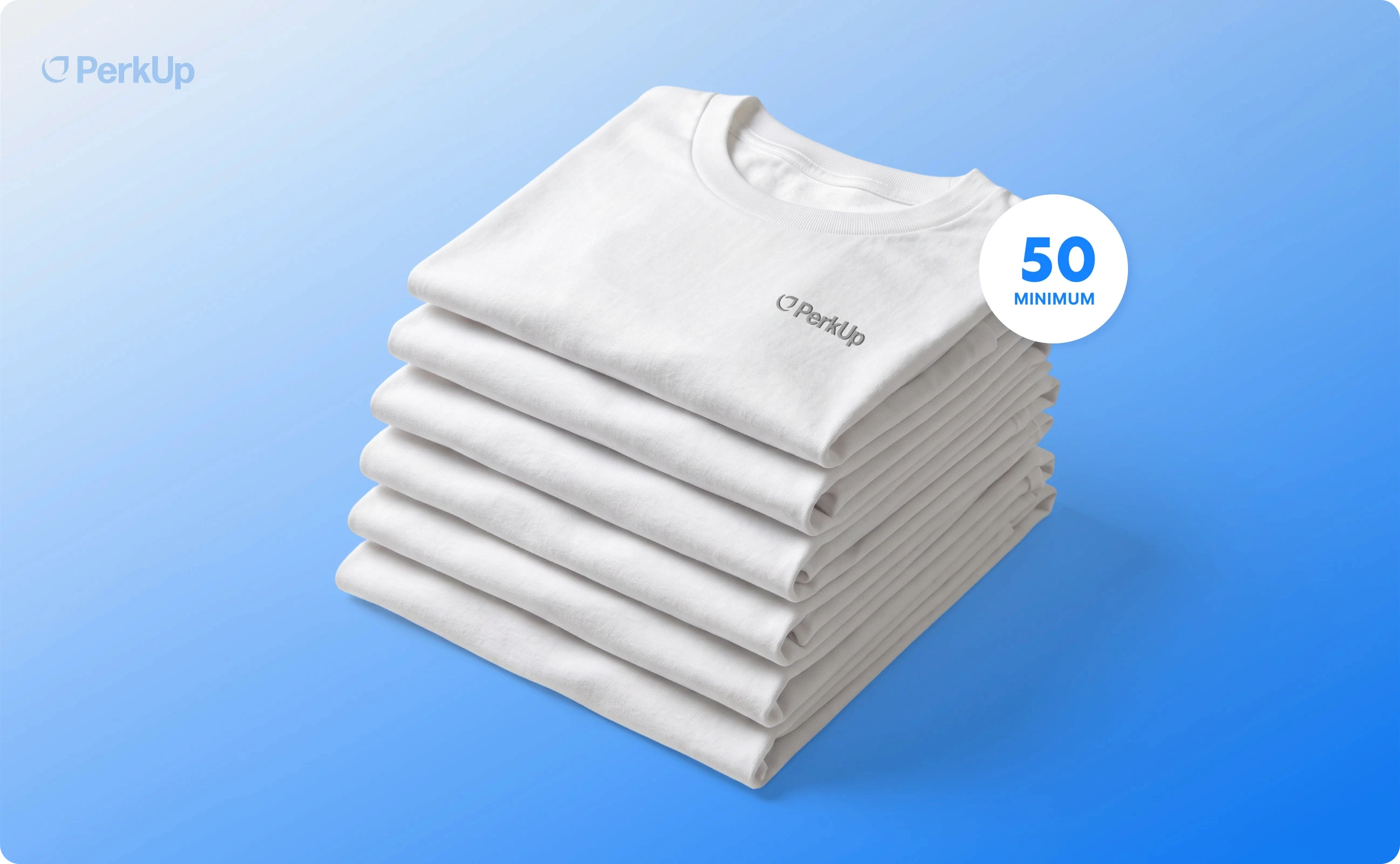
Bulk swag handles larger production runs. Plan on roughly five to six weeks before the first shipment leaves the warehouse: three weeks for production, one week for kitting, and one week for approvals. Apparel items in bulk are produced ahead of time, stored in a warehouse, and then shipped within a few business days whenever someone needs one.


Apparel Dos and Don’ts

If you only remember one thing from this guide, make it this: the dos and don’ts of ordering apparel swag.

Do

  • Read the spec sheet before the price. Fabric weight, spinning method, construction, and size range tell you far more about how a garment will wear.

  • Choose the decoration method first. Your artwork quickly narrows the garments that will work well, and changing direction after you've chosen a blank is expensive.

  • Let your recipients choose their own size. A swag store or On Demand ordering can help you avoid wasted apparel inventory.

  • Check brand availability before approving a style. Make sure every destination on your list can actually receive the apparel items.

  • Approve one physical sample and stick to it. Replicating the same approved specification across every region is the easiest way to keep a global apparel program consistent.

Don't

  • Don't use event artwork on employee apparel. A logo designed to stand out across a trade show floor rarely becomes something people want to wear on the weekend.

  • Don't plan apparel for a last-minute global send. Sizes are usually what slow international programs down. When time is tight, non-sized swag like drinkware is often the safer choice.

  • Don't buy bulk for people you can't name yet. Unsold inventory ties up warehouse space and budget.

  • Don't promise delivery dates before approvals finish. Every proof round adds 2 to 4 business days (which can still vary), and cross-region sourcing can add roughly two more weeks.

  • Don't ship Deliver Duty Unpaid unless you have to. Unless you absolutely can’t ship DDP, then don’t let your recipients pay for customs and other fees.


How PerkUp Runs Apparel for Global Teams
Most apparel programs don't run on a single order type. You may need t-shirts for your onboarding or a premium Peter Millar for your executives. Ordering from different suppliers can only cause you headaches and missed deadlines. 

That’s why working with a swag management platform like PerkUp is especially important when it comes to swag apparel campaigns. From one platform, you can run bulk swag, On Demand swag, event swag, swag stores, swag kits, and even gift cards, using whichever approach fits your budget, your recipients, and the occasion.

That flexibility is also applicable to sourcing. PerkUp has more than 1,000 On Demand items with a 1-unit minimum, so you can send one hoodie in one size without committing to a larger run. Your recipients get to choose the size and style that works for them. And since PerkUp produces the On Demand swag apparel item after it’s ordered, and there’s no inventory sitting around afterward. Plus, its bulk catalog has thousands of options for larger programs. And if apparel isn't the right fit, PerkUp’s catalog includes 5,000+ gift cards, too.

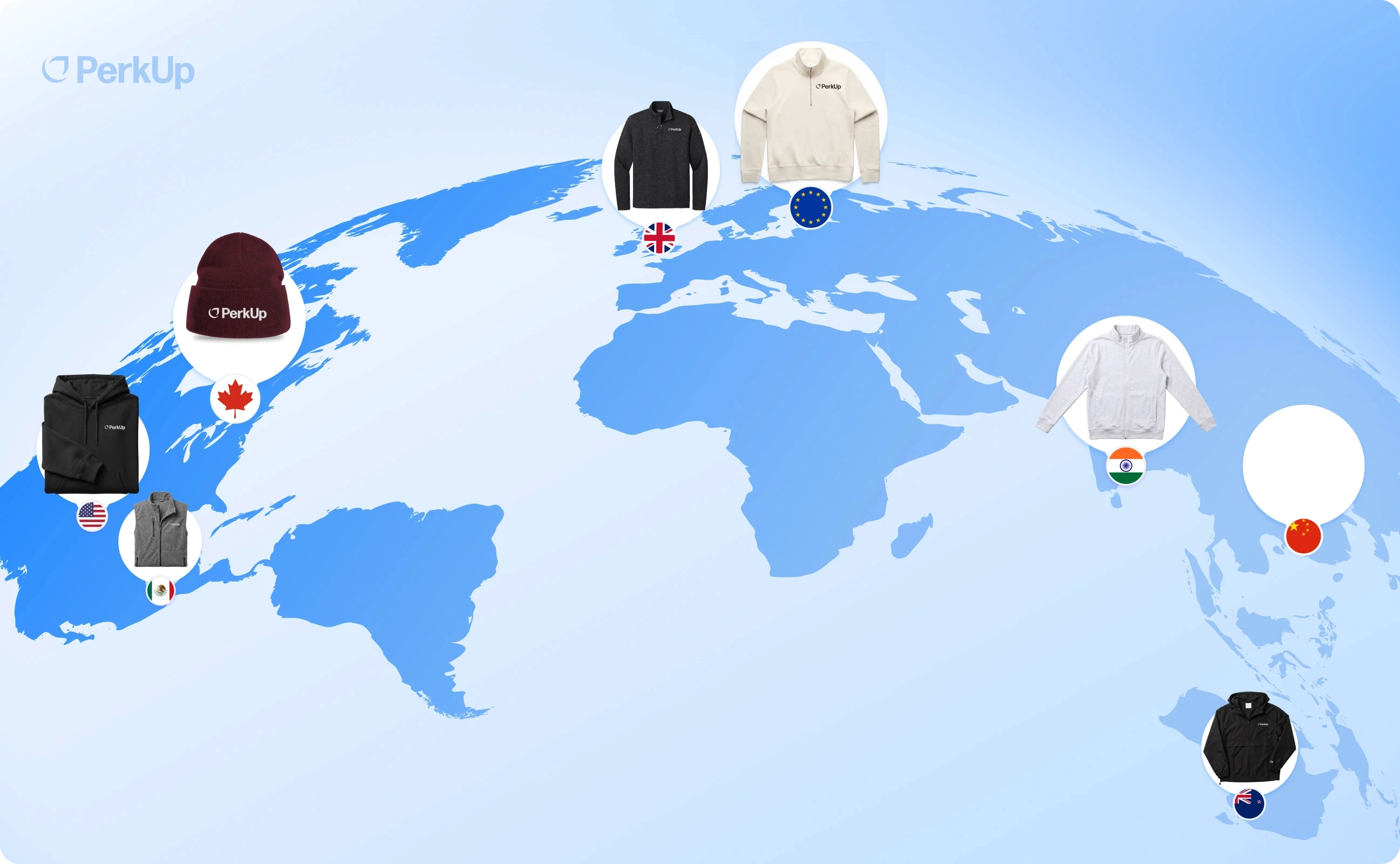
PerkUp operates warehouses in the US, Canada, Mexico, the UK, Europe, India, China, and Australia, reaching more than 65 countries with duties prepaid wherever possible. Additionally, the platform also has an in-house design team that creates mockups, reviews artwork, and advises on decoration methods at no additional cost, so you don’t have to figure out decoration methods on your own. And because your recipients can also order through a branded swag store (if that’s what you’ll go for), they can choose their own size, fit, and style within the budget you set, which dramatically reduces sizing mistakes and leftover inventory.

PerkUp also has 200+ integrations, allowing you to automate your milestone gifting so that you can send apparel items or any other swag items to your recipients on their birthdays, work anniversaries, or onboarding.

Apparel programs PerkUp has built

Microsoft
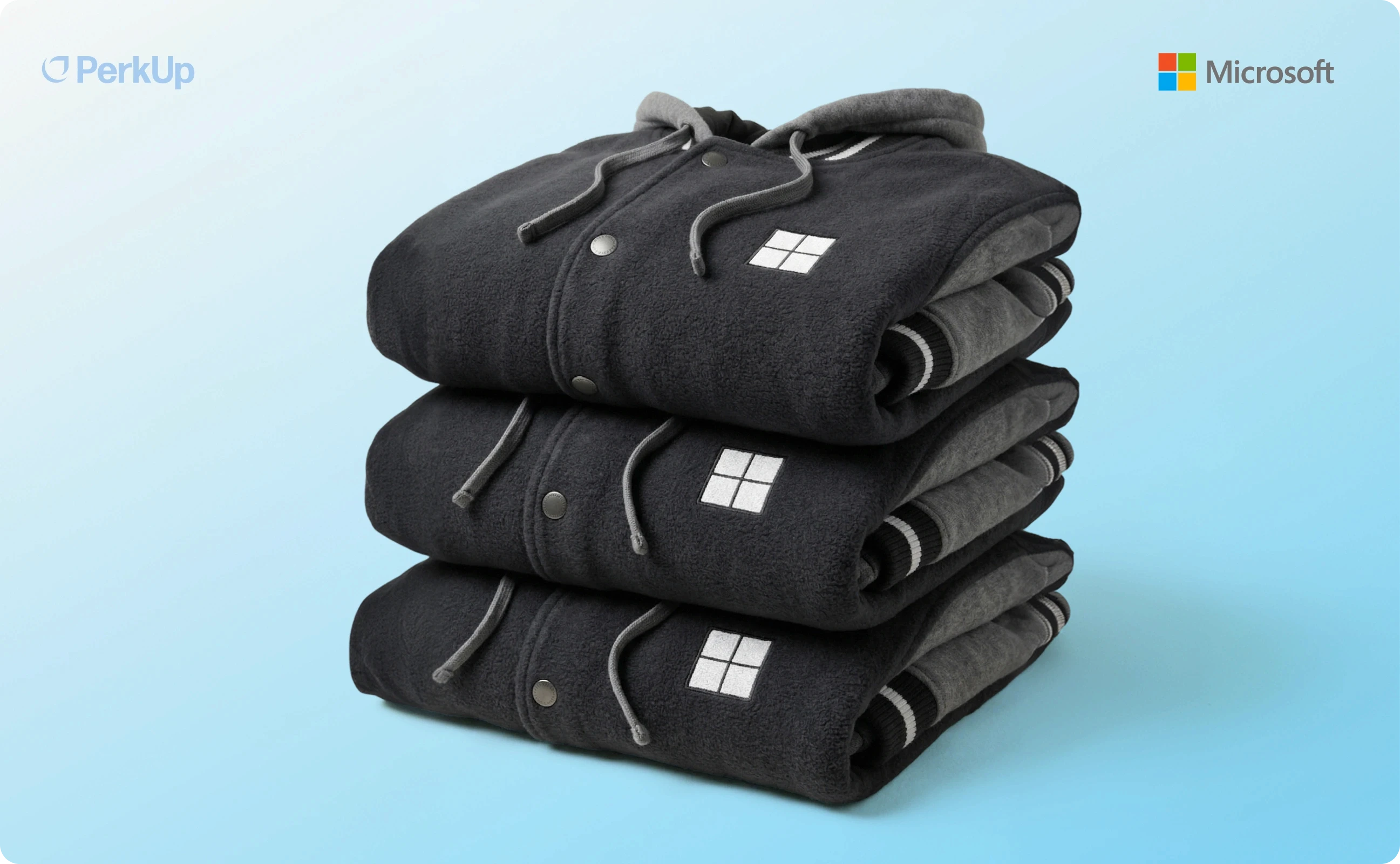
PerkUp produced premium custom letterman jackets for Microsoft. Between the materials, decoration, and presentation, the program focused on creating something recipients would keep and use often.

Impiricus
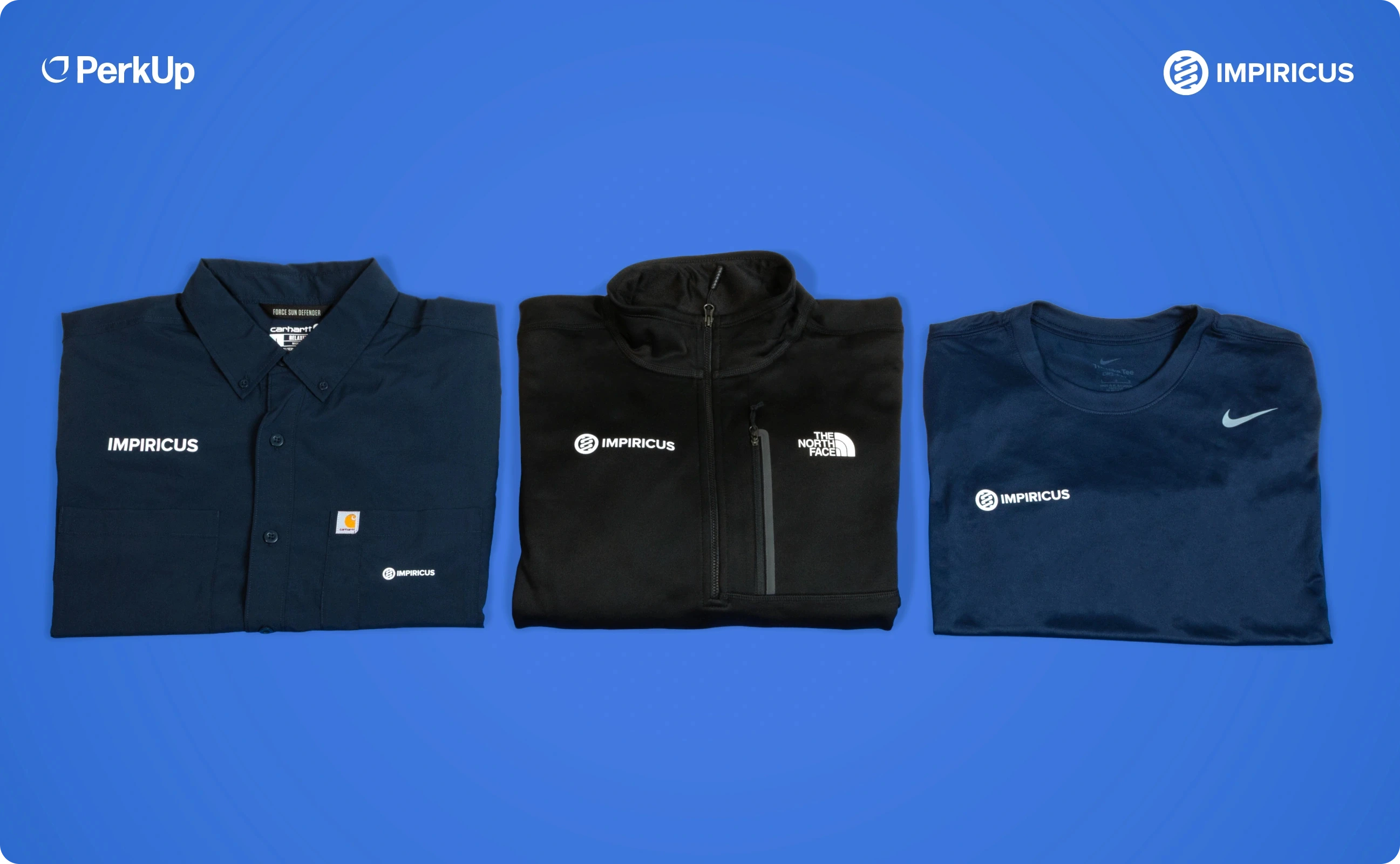
Impiricus used PerkUp to build a branded apparel program designed for repeat ordering. Impiricus then had a consistent look on their swag items across multiple orders, teams, and campaigns without rebuilding the program every time.

Wise
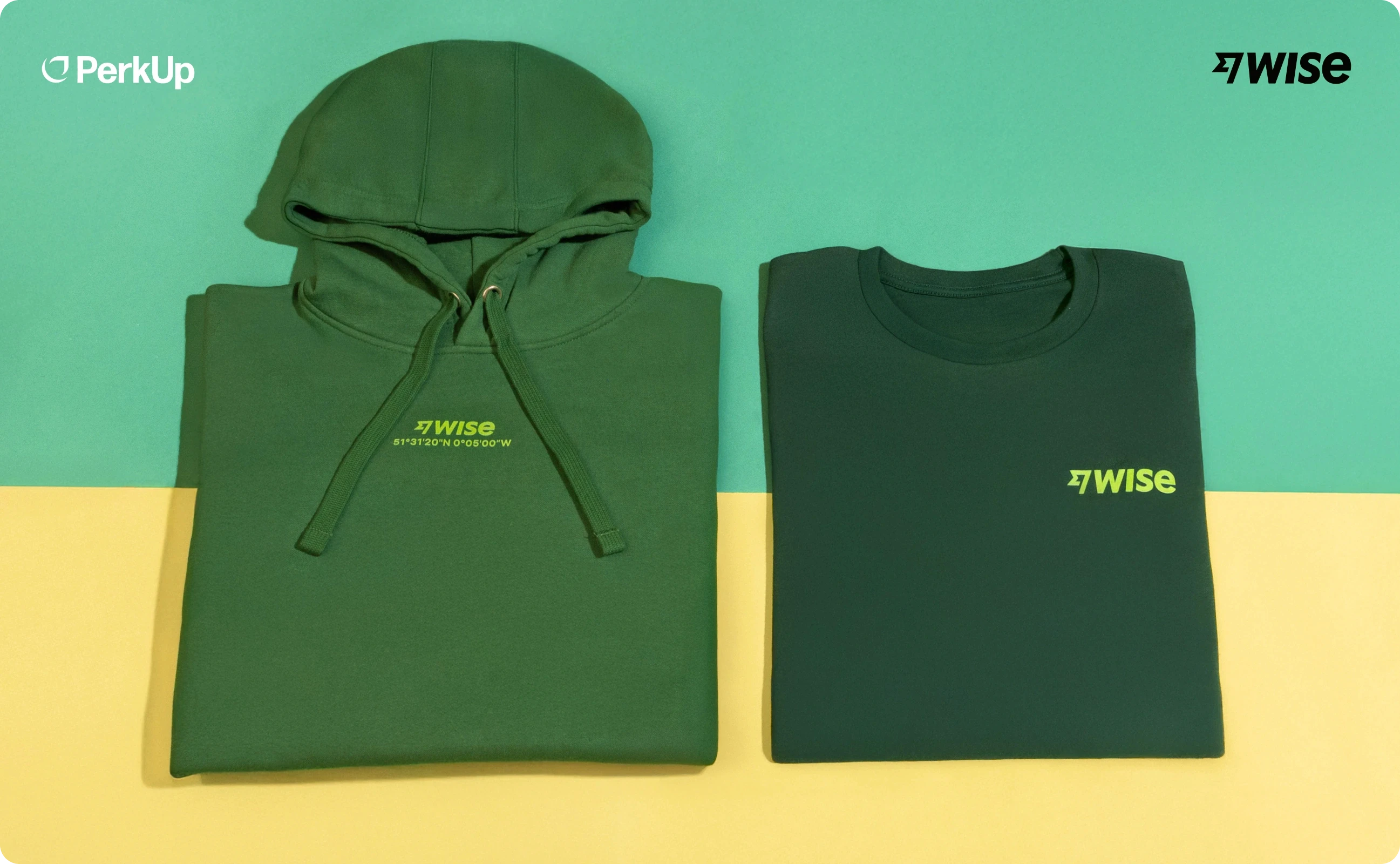
Wise partnered with PerkUp on embroidered internal team apparel built for everyday wear. The swag program focused on apparel that employees would actually wear while working.


Key Takeaways

Good apparel programs are the result of getting a dozen small decisions done right. Choose a fabric people actually want to wear. Match the decoration method to the garment. Give recipients a way to pick their own size. Plan production around the timeline you actually have. Do all of that consistently, and your apparel becomes something your recipients will actually use.

If you'd rather spend your time choosing the apparel than managing production schedules, decoration proofs, and global fulfillment, then work with PerkUp so the platform can handle the rest. From one platform, you can run On Demand orders, bulk programs, swag kits, branded apparel stores, and international fulfillment, all backed by regional warehouses and an in-house design team.

Frequently Asked Questions

What customization options are available for company apparel?

You can customize the garment itself, decoration method, placement, packaging, and even the online ordering experience. Decoration options include embroidery, screen printing, DTG, and DTF, depending on the garment. Additional placements, like sleeve hits, second logos, nape prints, or woven labels, are priced separately from the blank. All of these customization options are available on PerkUp.

What are typical turnaround times for custom branded apparel?

With PerkUp, On Demand apparel typically arrives in about three weeks, since production begins after each order is placed. Bulk apparel generally requires three weeks of production, plus one week for kitting and one week for approvals. International sourcing can add roughly two weeks.

What are the minimum order quantities for branded apparel?

It depends on the production method. On Demand apparel has a 1-unit minimum, making it ideal for one-off orders. Bulk minimums vary by garment and decoration method, but generally begin around 50 units per SKU per warehouse location. PerkUp offers both swag order types.

When should you use On Demand apparel instead of bulk?

Use On Demand when quantities or recipients aren't known in advance, such as onboarding, milestone gifts, or international employee sends. Use bulk when timing and volume are predictable, like conferences, product launches, or annual employee programs. 

Can you put more than one logo on the same garment?

Yes. Multi-logo apparel is common for co-branded events, partnerships, acquisitions, and sponsorships. PerkUp supports multiple brands under one account, and additional decoration placements are priced separately. 
import { useEffect } from "react"


export default function CarouselFixer() {

useEffect(() => {

// Wait for CMS content to render

const init = () => {

// Find all horizontally scrollable containers inside CMS content

const contents = document.querySelectorAll(".framer-text, [class*='content'], [class*='Content']")


contents.forEach((content) => {

const scrollEls = content.querySelectorAll("ul, ol, div")

scrollEls.forEach((el) => {

const htmlEl = el as HTMLElement

const style = window.getComputedStyle(htmlEl)


// Target only elements that overflow horizontally (the carousel)

if (

style.overflowX === "scroll" ||

style.overflowX === "auto" ||

htmlEl.scrollWidth > htmlEl.clientWidth

) {

attachScrollBehavior(htmlEl)

}

})

})

}


const attachScrollBehavior = (el: HTMLElement) => {

// Prevent double-attaching

if (el.dataset.scrollFixed) return

el.dataset.scrollFixed = "true"


el.style.cursor = "grab"

el.style.userSelect = "none"

el.style.webkitOverflowScrolling = "touch"

el.style.scrollbarWidth = "none"


let startX = 0

let scrollStart = 0

let isDown = false

let dragged = false


const onMouseDown = (e: MouseEvent) => {

isDown = true

dragged = false

startX = e.clientX

scrollStart = el.scrollLeft

el.style.cursor = "grabbing"

}


const onMouseMove = (e: MouseEvent) => {

if (!isDown) return

const dx = e.clientX - startX

if (Math.abs(dx) > 5) dragged = true

el.scrollLeft = scrollStart - dx

}


const onMouseUp = () => {

isDown = false

el.style.cursor = "grab"

}


const onClickCapture = (e: MouseEvent) => {

if (dragged) {

e.preventDefault()

e.stopImmediatePropagation()

dragged = false

}

}


const onWheel = (e: WheelEvent) => {

if (Math.abs(e.deltaX) > 0) {

e.preventDefault()

el.scrollLeft += e.deltaX

}

}


el.addEventListener("mousedown", onMouseDown)

el.addEventListener("mousemove", onMouseMove)

el.addEventListener("mouseup", onMouseUp)

el.addEventListener("mouseleave", onMouseUp)

el.addEventListener("click", onClickCapture, true)

el.addEventListener("wheel", onWheel, { passive: false })

}


// Try immediately, then retry after delays to catch late CMS renders

init()

setTimeout(init, 500)

setTimeout(init, 1500)

}, [])


// Renders nothing — invisible helper

return null

}

Start sending incredible swag and gifts globally

Simplify and enhance your event swag and gifting experience for better retention, engagement and productivity.

Start sending incredible swag and gifts globally

Simplify and enhance your event swag and gifting experience for better retention, engagement and productivity.

Start sending incredible swag and gifts globally

Simplify and enhance your event swag and gifting experience for better retention, engagement and productivity.